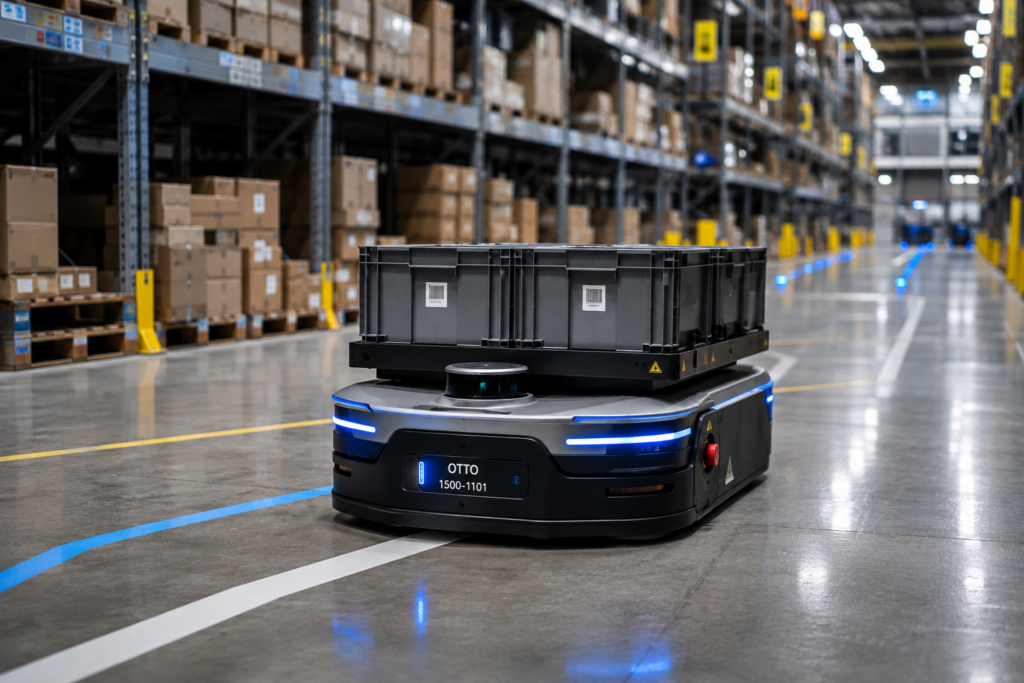
You’ve got a facility. You’ve got product that needs to move , from receiving to staging, from picking zones to pack-out, from one workstation to the next. You’ve probably looked at conveyors, you’ve maybe run the numbers on AGVs, and now someone on your team is saying “what about AMRs?”
It’s a fair question. AMR stands for Autonomous Mobile Robot, and the category has exploded in the last five years. But the term gets thrown around loosely, the vendor marketing is aggressive, and the actual technical differences between AMRs and older mobile automation aren’t always explained clearly. This guide fixes that. By the end, you’ll know exactly what an AMR robot is, how it works mechanically and programmatically, where it fits in a real facility, and what specs actually matter when you’re evaluating one.
How an AMR Robot Is Different from an AGV
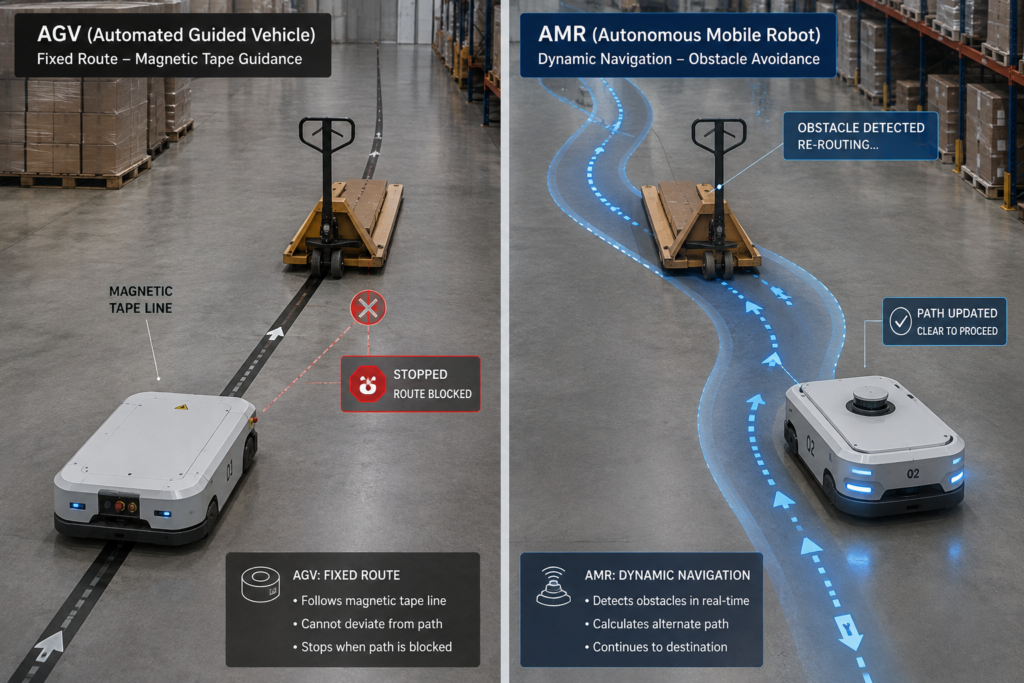
The comparison to AGVs always comes up first, and it matters. A traditional AGV (Automated Guided Vehicle) follows a fixed physical path , magnetic tape, embedded wire, QR codes on the floor. It knows where it’s supposed to go because you told the infrastructure where to point it. Change the floor layout, and you’re pulling up tape and reprinting markers.
An AMR doesn’t follow a fixed path. It builds a map of its environment using onboard sensors , typically LIDAR, cameras, or a combination , and navigates dynamically. It decides its own route in real time, avoids obstacles, and reroutes when something’s in the way.
I’ve seen facilities try to use AGVs in high-traffic picking zones. It doesn’t go well. A pallet jack parked two feet off the edge of the lane shuts down the entire AGV route until someone moves it. The AMR just goes around it.
That flexibility isn’t magic. It comes from a software layer called SLAM , Simultaneous Localization and Mapping. The robot continuously builds and updates its position estimate against a known map. Most commercial AMRs use a pre-mapped environment but dynamically handle obstacles within it. Some higher-end platforms support fully unknown environments, but for most warehousing and manufacturing deployments, you’ll map the facility during commissioning and the robot navigates against that reference.
The practical upshot: AMRs tolerate messy, real-world environments far better than AGVs. That’s the real difference. Not the technology for its own sake , the tolerance for operational chaos.
How AMR Navigation Actually Works
Let’s get into the hardware stack, because this is where AMR spec sheets get confusing fast.
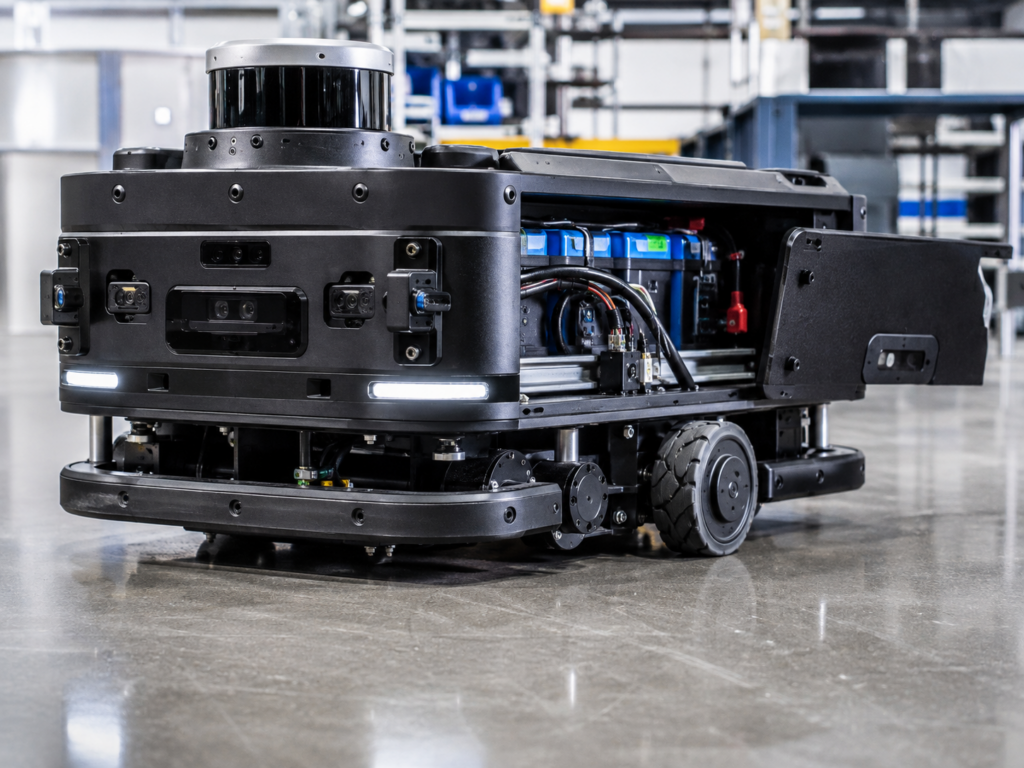
Most commercial AMRs use 2D LIDAR as the primary localization sensor. The LIDAR emits laser pulses in a horizontal plane, measures return times, and builds a point-cloud slice of the environment at roughly hub height. The robot compares this live scan against its stored map to figure out where it is. Units like the Sick TiM series or Hokuyo UST are common in mid-range platforms. Higher-end AMRs layer in 3D LIDAR or stereo cameras for better obstacle detection , critical in environments with low-profile hazards like cables on the floor or objects below the LIDAR plane.
Payload sensors matter too. If your AMR is picking up totes or pallets autonomously, you need load detection to confirm the pickup was successful before the robot starts moving. I spent weeks debugging what I thought was a fleet management software problem before realizing a particular AMR model we were testing had no load confirmation sensor , it was just assuming a successful pickup based on docking position. Wrong assumption, missed totes, downstream line stoppages. Don’t skip that spec.
Battery system is another underrated consideration. Most AMRs run lithium-ion packs in the 24V–48V range. Cycle count matters , look for 2,000+ charge cycles before significant capacity degradation. Autonomous opportunity charging (where the robot docks itself when idle) is standard now on serious platforms and is worth requiring. Scheduled charging windows kill throughput.
Fleet management software is where AMR robotics really differentiates between vendors. The AMR itself is almost a commodity at this point. The fleet orchestration layer , traffic management, task allocation, integration with your WMS , is where deployments succeed or fail. Evaluate the software as hard as you evaluate the hardware.
AMR Payload and Speed: What the Specs Actually Mean
When you pull an AMR spec sheet, three numbers jump out: payload capacity, max speed, and battery runtime. All three require context.
Payload is listed as a maximum static load. A robot rated for 1,000 kg payload can carry that weight , but acceleration and braking behavior change significantly when it’s near capacity. Check the rated speed at full payload, not just the top speed at no load. Some manufacturers list top speed at 2 m/s but their tested throughput speed at full payload is 0.8 m/s. That changes your cycle time math dramatically.
Speed in warehouse and manufacturing AMR deployments is almost always constrained by your facility’s safety zones anyway. Most deployments run AMRs at 1.0–1.5 m/s in pedestrian-shared zones per ISO 3691-4, which covers industrial trucks operating in driverless mode. If your facility has pedestrian-free corridors, you can run faster , but you need proper zone control infrastructure to enforce it.
Battery runtime is rated under specific conditions that usually don’t match your application. A runtime listed at 8 hours assumes a defined duty cycle and ambient temperature. In a cold storage facility running at 4°C, expect meaningful capacity reduction. Runtime specs from vendors like MiR, Fetch Robotics, or Geek+ are generally honest, but always ask for the test methodology behind the number.
Runtime connects directly to fleet sizing. If your AMR has a 6-hour operational runtime and a 2-hour charge window, you need at minimum a 1.33:1 robot-to-active-slot ratio to maintain continuous coverage. In practice, you’re building in redundancy on top of that.
Where AMR Automation Fits in a Real Facility
AMRs aren’t a universal answer. They’re the right answer in specific operational contexts, and forcing them into the wrong application costs you money.
AMRs perform best in goods-to-person picking workflows, inter-zone transport, and line-side replenishment in manufacturing. Anywhere the route changes frequently, the environment is dynamic, or the facility layout needs to evolve , AMRs win over fixed infrastructure.
They struggle with high-speed, high-throughput sortation where a fixed conveyor will simply outrun them on cycle time. They also struggle in very tight spaces , narrow-aisle racking environments below 1.8 meters of clear width start to create real navigation headaches depending on the platform. Always confirm your minimum aisle clearance against the AMR’s footprint plus its sensor margins. The robot’s physical width isn’t the operating width.
The first time I saw this mistake was in a client facility that had validated AMR aisle compatibility on paper but hadn’t accounted for pallet overhang at the bottom of rack positions. The AMR’s LIDAR saw the pallet overhang as an obstacle and wouldn’t proceed. Simple fix once identified, but it delayed commissioning by three weeks.
AMRs also integrate differently than conveyors or robot arms. They connect to your operation at the software layer , your WMS, ERP, or MES feeds tasks to the fleet management system, which dispatches individual robots. That API integration is real work. Factor it into your project timeline. ISO 23221, which covers mobile robot fleet management interfaces, is worth reviewing before you commit to a vendor if interoperability matters to your stack.
Evaluating an AMR Platform: What to Ask Before You Buy
You’re not buying one AMR. You’re buying a fleet, a software platform, and a long-term integration commitment. Here’s what to pressure-test before you sign anything.
Ask for a payload-speed curve, not just peak specs. Ask for obstacle detection range at full operating speed and minimum stopping distance. Those two numbers together tell you whether your safety zone widths are adequate.
Ask about fleet scalability , specifically, at what fleet size does the traffic management software start requiring manual intervention. Some platforms that work beautifully at five robots become a congestion nightmare at twenty-five without dedicated traffic engineering.
Ask for uptime data from reference deployments, not theoretical MTBF. Mean time between failures calculated from component specs and actual uptime logged in production are very different numbers. Vendors with mature deployments can give you real data. If they can’t or won’t, that tells you something.
Check certification status. For North American deployments, look for UL 3100 compliance , the standard for autonomous mobile robots. For EU deployments, CE marking under the Machinery Directive is the baseline. Certifications aren’t a guarantee of performance, but they are a baseline for safety architecture.
Finally, ask about the total cost of software licensing over five years, not just the hardware purchase price. Some AMR platforms have aggressive upfront hardware pricing with ongoing fleet management software fees that significantly change your TCO. Get the full five-year number before you compare platforms.
Browse the full range of mobile robots and AMR platforms at factoryrobots.net/shop/ , full specs and pricing on every listing, no quote form required.
Key Takeaways
- AMRs navigate dynamically using LIDAR and SLAM , they reroute around obstacles in real time without fixed floor infrastructure.
- Payload speed curves matter more than peak specs , confirm rated throughput speed at full load before building your cycle time model.
- Fleet management software is where AMR deployments succeed or fail , evaluate the platform as hard as the hardware.
- Cold environments, narrow aisles, and pallet overhang are the three most common sources of commissioning delays , validate all three before finalizing layout.
- Get a five-year total cost of ownership number including software licensing before comparing platforms , hardware price alone is misleading.
Frequently Asked Questions
What is the difference between an AMR and an AGV? An AGV follows fixed physical guidance , magnetic tape, wire, or floor markers , and can’t reroute if something blocks its path. An AMR navigates autonomously using LIDAR and onboard mapping, choosing its own route and rerouting around obstacles in real time. For dynamic facility environments, AMRs are almost always the better fit.
What does SLAM mean in AMR robotics? SLAM stands for Simultaneous Localization and Mapping. It’s the algorithm that lets an AMR build a map of its environment and track its own position within that map at the same time. Most commercial AMRs use SLAM against a pre-built reference map, updating their position continuously as they move through the facility.
What safety standards apply to AMR robots in North America? UL 3100 is the primary standard for autonomous mobile robots in North American deployments. ISO 3691-4 covers driverless industrial trucks operating in shared pedestrian environments and defines requirements for speed limits and safety zone design. Both should be on your checklist before deployment.
How many AMRs do I need for my facility? It depends on your task volume, cycle times, battery runtime, and charging strategy. Start by mapping your daily task demand in robot-hours, then divide by operational hours per robot per shift accounting for charging windows. Build in at least 15–20% redundancy for maintenance and peak demand. A good fleet management vendor can help model this against your specific workflow before purchase.
Putting AMR Robotics to Work in Your Facility
AMR robots aren’t complicated in principle , they move things autonomously, navigate intelligently, and adapt to your environment in ways fixed automation can’t. Where it gets complicated is in the details: fleet sizing, software integration, aisle clearance, payload behavior under load, and five-year TCO. Those are the decisions that separate a smooth deployment from a three-month commissioning slog.
If you’re at the evaluation stage, start with your cycle time requirements and your floor plan. From there, the right platform usually becomes clear. For specs, pricing, and side-by-side comparisons on every platform we carry, factoryrobots.net has everything listed without a single quote form between you and the data you need.