
You’ve specced out the robot arm. You’ve mapped the reach envelope, confirmed the payload, and priced out the cell. Then someone asks, “What’s on the end of it?” and suddenly there’s a two-week delay while everyone figures out the tooling.
End effectors are the part of the system that actually touches the work. They determine whether your robot can do the job at all. The arm is just transport , the end effector is the point. Most integration failures I’ve seen in the field weren’t about the robot. They were about a gripper that couldn’t hold the part, a tool that couldn’t hit the cycle time, or a flange interface nobody checked until it was too late. This guide covers what end effectors are, the main types, and how to pick the right one before you order anything.
What Is an End Effector?
An end effector is any device mounted to the terminal flange of a robot arm that interacts with the workpiece or environment. Think of it as the robot’s hand , or its welding torch, or its spray gun, or its camera. Whatever the robot needs to do physically, the end effector is what does it.
The term comes from robotics kinematics, where the “end” refers to the last link in the kinematic chain. In practice, engineers use “end effector,” “end-of-arm tooling” (EOAT), and “robot tool” interchangeably. They all mean the same thing.
End effectors connect to the robot via the tool flange, a standardized mounting face at the wrist. ISO 9283 covers robot interfaces, and most arms follow the ISO 9409-1 flange standard for bolt patterns and locating features. This matters because it’s how you ensure the tooling you buy actually bolts up to the arm you have. I’ve watched someone receive a beautiful pneumatic gripper only to discover the flange pattern was M6 where the arm expected M5. Two-day delay, easily avoided.
The end effector also communicates with the robot controller. Simple tools use discrete I/O , a digital signal to open, another to close. More complex systems use fieldbus protocols like EtherNet/IP, PROFINET, or IO-Link to pass force feedback, position data, or status bytes back to the controller. When you’re evaluating end effectors, the communication interface is just as important as the mechanical interface.
Payload capacity is the last check. The robot’s rated payload includes the end effector weight plus the part weight. A 10 kg robot carrying a 3 kg gripper has 7 kg left for the actual workpiece. That’s a common mistake , speccing the arm for part weight, then forgetting to subtract tooling mass.
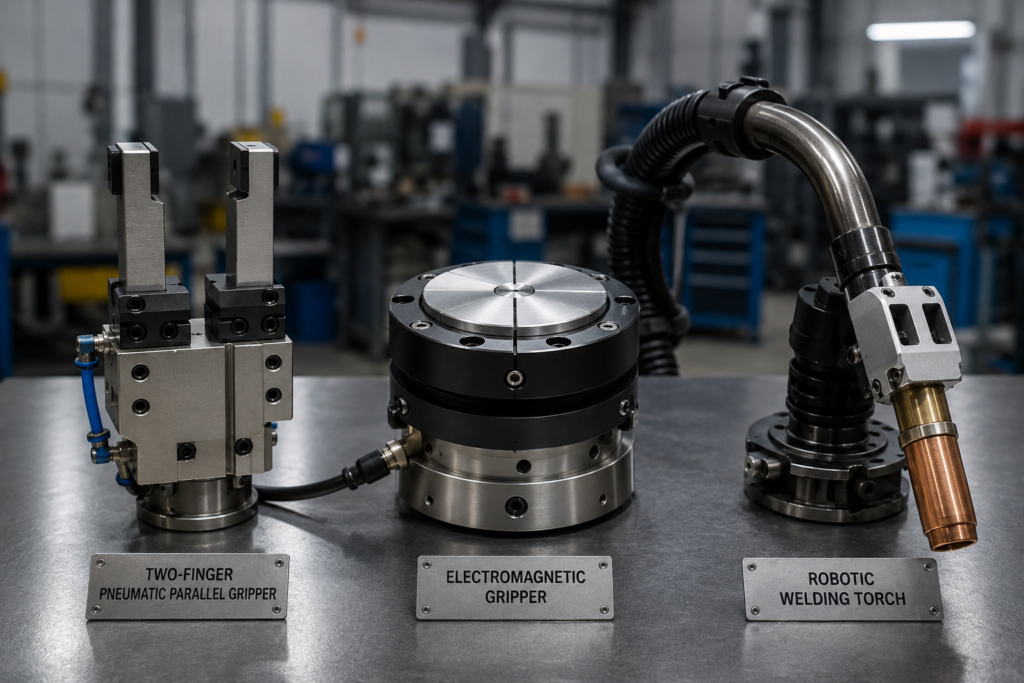
Types of Robot End Effectors
End effectors fall into two broad families: grippers, which manipulate objects physically, and process tools, which perform an operation on the workpiece. Here’s how the main categories break down.
Grippers
Grippers are the most common end effector type in factory automation. The job is simple: pick up a part, move it, put it down. The variety comes from how they generate grip force and what geometry they use.
Pneumatic grippers use compressed air to actuate fingers. They’re fast, robust, and cheap. A standard parallel pneumatic gripper from Schunk or SMC can open and close in under 100 milliseconds and handle tens of millions of cycles before needing service. The limitation is binary control , most are either open or closed, with no force feedback unless you add sensors.
Electric grippers use servo or stepper motors. They’re slower than pneumatics but programmable , you can set grip force, finger position, and speed in software. For delicate parts or variable part sizes, this matters. The RobotIQ 2F-85 is a well-known example: configurable grip width from 0 to 85 mm, grip force from 20 to 235 N, all over a single cable with IO-Link communication. Electric grippers cost more upfront but eliminate the pneumatic supply requirement, which matters in clean rooms or where compressed air is scarce.
Vacuum grippers use suction cups to lift flat or lightly contoured surfaces. Cardboard boxes, sheet metal blanks, glass panels, plastic bags , anything with a smooth, non-porous surface is a candidate. Suction force depends on cup area and vacuum level. A 40 mm cup at -0.6 bar will generate roughly 75 N of holding force. Stack four of them and you’ve got 300 N, which handles most light panel work fine.
Magnetic grippers use permanent magnets or electromagnets to handle ferrous parts. Fast, no wear, no air supply. The downside is obvious: they only work on steel and iron, and they can attract chips and swarf if the cell isn’t clean.
Soft grippers use compliant silicone or foam structures to handle irregular or fragile objects. Common in food processing and pharma, where hard jaws would damage the product.
Process Tools
Process tools skip the pick-and-place step entirely. The robot positions the tool; the tool does work directly on the part.
Welding torches are the classic example. A MIG torch on a FANUC arc welding robot is an end effector. So is a spot welding gun, a plasma cutting head, a dispensing nozzle for adhesive or sealant, a deburring spindle, or a grinding wheel. These tools often require their own power and signal routing through a dress package , the bundle of cables, hoses, and conduit that runs from the robot base to the tool. Dress package routing is one of the most overlooked integration headaches in robotic welding and machining cells.
How End Effectors Affect Cycle Time and Reliability
The end effector is almost always the reliability bottleneck in a robot cell. The arm itself will run for 80,000 hours between failures. The gripper, if you spec it wrong, might need rebuilding every few months.
The first time I saw this go wrong was in a stamped metal transfer line where the team had spec’d a pneumatic gripper for a cycle time of 0.8 seconds per pick. The gripper met that spec , on the bench. On the line, the part was hot from the press and had oil film on it. Grip force dropped 30%, and parts were dropping at a rate of one per shift. The fix was a different cup material and an air-blow purge cycle before gripping. A simple field problem, but it cost three weeks to diagnose and correct.
Cycle time depends on gripper actuation speed, settle time, and how reliably the sensor confirms grip before the robot moves. Pneumatic grippers are fast but can suffer from inconsistent actuation if your shop air pressure fluctuates. Electric grippers are more consistent but add 50-150 ms to each cycle. That delta adds up at high volumes.
Reliability is also a function of how well the end effector is rated for the environment. Wash-down grippers for food lines need IP67 or IP69K ratings. Grippers working near weld spatter need heat shields and regular cleaning cycles. Vacuum cups near coolant mist need filters and separators upstream. Ignore the environment and you’re buying replacement tooling quarterly.

How to Choose the Right End Effector
Start with the part. Not the robot, not the budget. The part geometry, weight, surface condition, and fragility define what’s physically possible.
Work through these in order. What’s the part weight with safety factor? (Multiply actual weight by 1.5 minimum to account for acceleration forces during high-speed moves.) What’s the surface , flat, contoured, porous, oily, hot? What’s the required position repeatability at the point of contact? A gripper that positions to ±0.5 mm won’t work if your downstream fixture needs ±0.1 mm.
Then check the robot interface. Confirm the flange standard (ISO 9409-1 is common, but verify the size , A50, A63, A100 are different bolt patterns). Confirm the utility connections , does your robot have through-arm air channels? How many? Is there a hollow wrist for cable routing? These details determine whether a given end effector integrates cleanly or requires external routing that eats into reach and creates wear points.
ISO 10218 covers safety requirements for industrial robots, and end effector force limits fall under that scope when collaborative robots are involved. If you’re running a cobot , a UR10e, an ABB CRB 15000, a Fanuc CR-35iA , the gripper grip force must stay within limits that protect a human contact event. The ISO/TS 15066 standard for collaborative robots specifies force and pressure thresholds at the tool center point. Know those numbers before you lock in an electric gripper with 400 N of force capability on a cobot cell.
Also look at the total cost of ownership, not the unit price. A $400 pneumatic gripper that needs seals replaced every six months at four hours of downtime each time costs more over three years than an $1,100 electric gripper that runs maintenance-free. Do the math. The A3 Association for Advancing Automation publishes useful guidance on robot TCO if you want a framework.
Matching End Effectors to Robot Types
Not every end effector fits every robot type. The robot’s kinematic structure, max speed, and environmental design all constrain your choices.
Delta robots run extremely high cycle rates , up to 200+ picks per minute in some configurations. The end effectors on delta robots are almost always lightweight vacuum cups or small pneumatic grippers. At those speeds, anything heavy destroys the dynamics calculation. Keep tooling under 500 g if you can.
SCARA robots are common in light assembly. Small pneumatic grippers and precision electric grippers are the standard fit. The SCARA’s stiff in-plane motion makes it well-suited for press-fit and insertion tasks where a compliant tool mount helps absorb Z-axis errors.
Articulated 6-axis robots are the most flexible platform. They’ll carry welding torches, dispensing guns, multi-cup vacuum tools, or heavy-duty parallel grippers depending on payload class. Smaller articulated arms in the 3-10 kg payload range are typically paired with compact pneumatic or electric grippers. Larger arms , 50 kg and above , handle full weld gun assemblies, part transfer tools for heavy castings, or multi-tool turrets.
Collaborative robots have specific end effector requirements around force, weight, and safety-rated I/O as noted above. The cobot market has driven strong growth in purpose-built electric grippers with safety-rated outputs.
Browse the full robot selection at factoryrobots.net/shop/ and use the compare tool to cross-reference payload and flange specs before committing to a tooling solution.
Key Takeaways
- Always spec the end effector from the part outward , part weight (×1.5 safety factor), surface condition, and positional accuracy requirements come before gripper selection.
- Confirm the flange interface standard (ISO 9409-1) and physical size code before purchasing , M5 vs M6 bolts and A63 vs A100 patterns are not interchangeable.
- Pneumatic grippers are fast and cheap but require stable shop air and binary control; electric grippers cost more but give you programmable force and position with no pneumatic supply.
- On cobots, end effector grip force must comply with ISO/TS 15066 contact force thresholds , don’t spec a high-force gripper on a collaborative cell without checking this.
- Total cost of ownership matters more than unit price , a cheap gripper with high maintenance frequency almost always costs more over a three-year horizon.
Frequently Asked Questions
What’s the difference between an end effector and a gripper? A gripper is one type of end effector , specifically, a tool designed to grasp and hold objects. End effector is the broader category that includes grippers, welding torches, dispensing guns, deburring spindles, and any other tool mounted to the robot’s wrist. All grippers are end effectors, but not all end effectors are grippers.
How do I know if an end effector is compatible with my robot arm? Check the tool flange standard on both the robot and the end effector. Most industrial robots follow ISO 9409-1 with a specific size code (A50, A63, A100, etc.). Confirm the bolt circle diameter, bolt size, and locating pin position match. Also verify the utility interface , air ports, signal connectors, and any through-arm cable channels , before purchasing.
Can I use the same end effector on different robot brands? Often yes, if both robots use the same ISO 9409-1 flange size. Many end effectors ship with adapter plates for common robot brands. The bigger compatibility variable is usually communication protocol , a gripper wired for EtherNet/IP needs controller support for that protocol, regardless of robot brand.
What is a tool changer and when do I need one? A tool changer is a quick-disconnect coupling that mounts between the robot flange and end effector, allowing the robot to swap tools automatically at a docking station. You need one when a single robot needs to perform multiple operations , pick-and-place, then inspection, then dispensing , without human intervention. ATI Industrial Automation and Schunk both make widely-used tool changer systems. They add weight and complexity, so only use them when the application genuinely requires multiple tools.
Choosing the Right End Effector for Your Cell
End effectors are where robot integrations succeed or fail. Get the gripper wrong and it doesn’t matter how well the arm is programmed. Work backwards from the part: weight, surface, geometry, environment, and cycle time. Then check the flange, the utilities, and the communication interface. In that order, every time.
If you’re still narrowing down robot platforms alongside tooling, start at factoryrobots.net , specs and pricing are on every product page, no quote forms required. And if you hit a specific integration question on flange standards or EOAT compatibility, the engineering support team at factoryrobots.net/support/ is there to work through it with you.