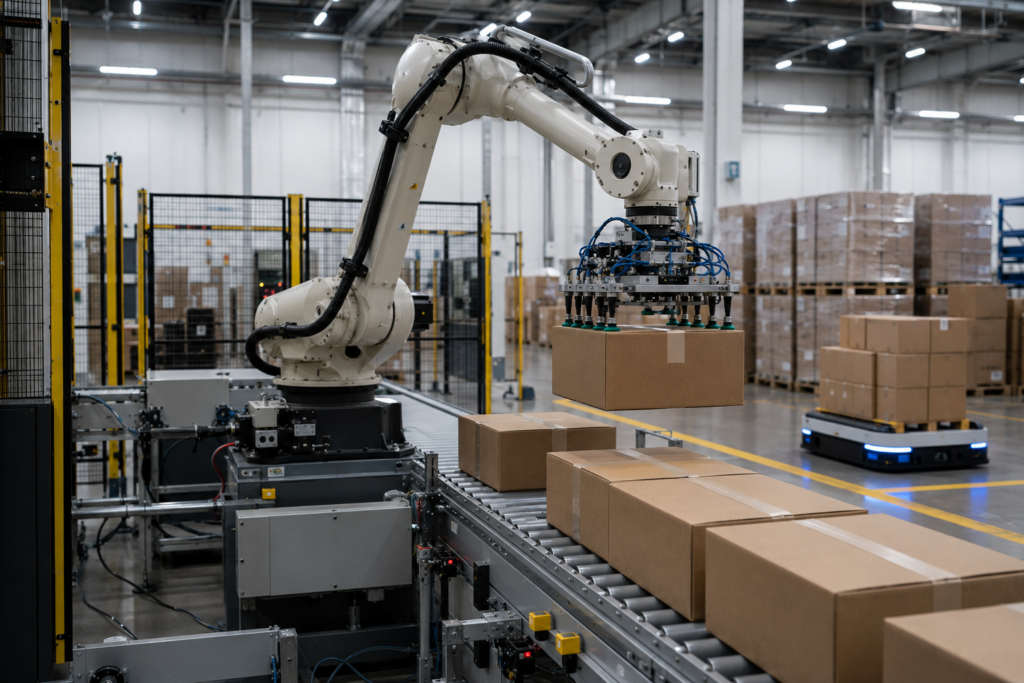
You’ve got a packaging line that works. Mostly. Two people on each shift hand-packing cartons, a third doing case erecting, and a fourth on palletizing. It runs fine until someone calls in sick, volumes spike, or you add a SKU and the whole flow breaks.
That’s where robotic packaging systems come in, not as a moonshot, but as a practical fix to a repeatable, high-volume problem. This guide walks through how these systems actually work, what specs to prioritize, where cobots make sense versus full industrial arms, and what a real deployment looks like from the floor up. No sales pitch. Just mechanics.
What Robotic Packaging Systems Actually Do
People use “robotic packaging” as a catch-all, but there are really four distinct functions: pick and place, case erecting and packing, wrapping and sealing, and palletizing. Most lines need two or three of these automated before the math starts working in their favor.
Pick and place is the most common entry point. A delta robot, think FANUC M-1iA or ABB IRB 360 , handles high-speed sorting, orientation, and placement into trays or cartons. These run 150-200 picks per minute on a clean product. Irregularly shaped items, sticky surfaces, or random infeed orientation will drop that number fast.
Case erecting and packing is where articulated arms shine. A KUKA KR 10 R1100 or a Universal Robots UR10e with a custom gripper can erect a flat blank, place product, fold flaps, and send the case downstream, all in one cell. Cycle time depends heavily on carton complexity, but 8-12 seconds per case is realistic for most CPG applications.
Palletizing is usually the highest ROI entry point for facilities not ready to automate the full line. A single articulated arm , FANUC M-410iC, KUKA KR 700, or even a cobot palletizer like the Doosan A0912 , can replace two to three headcount and run 24/7 without fatigue errors.
The first time I saw a packaging cell spec’d wrong, the engineer had picked a delta robot for carton loading because of its speed rating, then discovered the inertia limits couldn’t handle the carton weight at full cycle rate. Spec the payload at peak acceleration, not just static load.
Choosing Between Cobots and Industrial Arms
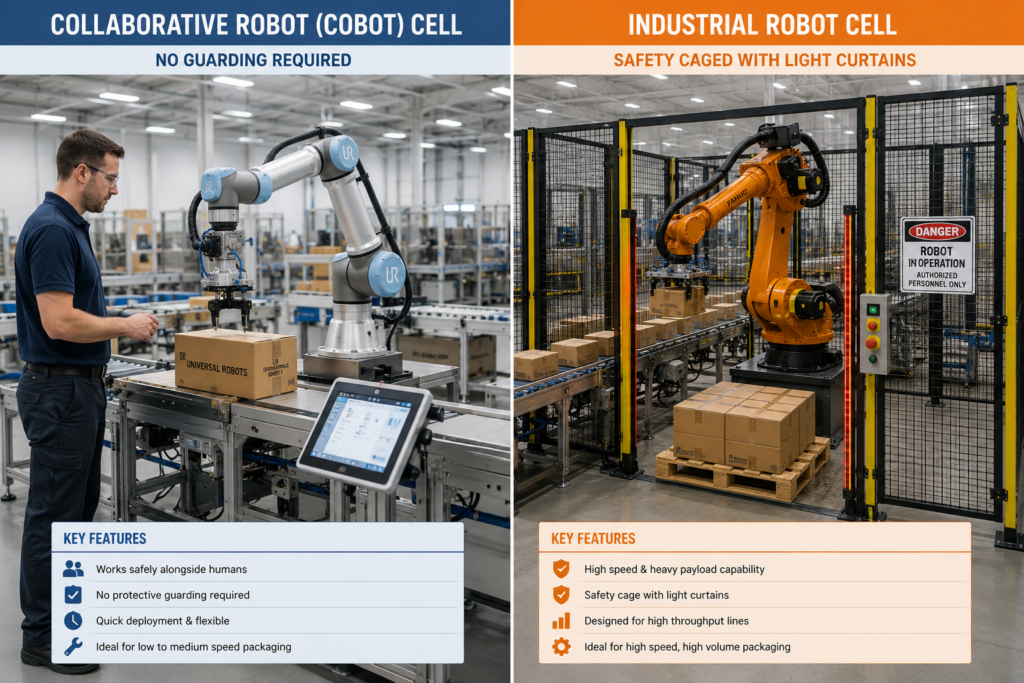
This is the question I get most often, and the answer isn’t “cobots are safer, so use those.” It’s about throughput, guarding real estate, and whether your line changes frequently.
Collaborative robots , UR, FANUC CRX, ABB GoFa, make sense when cycle times are forgiving (above 6 seconds per cycle), operators share the workspace, or you’re redeploying the robot to different tasks seasonally. They’re slower, lighter payload (most top out around 16 kg), and require force-limiting modes that cut speed further when a human enters the workspace.
Industrial arms are the right call when you need consistent sub-3-second cycle times, payloads above 20 kg, or a cell that runs the same task for years. The FANUC M-20iD/12L, for example, has a 12 kg payload and 1,885 mm reach , more than enough for most secondary packaging tasks, and it’ll run 60,000 hours before major maintenance.
The cobot packaging pitch gets oversold. I’ve seen facilities put in a UR10e on a palletizing task and then wonder why it can’t keep up with the line. The UR10e tops out at 10 kg payload and runs ISO/TS 15066 power-and-force limiting that drops TCP speed to 250 mm/s the moment the safety scanner trips. If your line runs 15 cases per minute, that cobot will be your bottleneck within a week.
Match the robot class to the actual cycle demand. Use our compare tool to run side-by-side specs on payload, reach, and cycle time before you commit.
Vision Systems and Infeed Control
A robot arm without a vision system is just a very fast, very dumb worker. For robotic packaging systems to handle real production conditions , mixed SKUs, random orientation, product gaps , you need machine vision integrated at the infeed.
The two standard approaches are 2D vision and 3D vision. 2D handles orientation correction and barcode-based SKU identification well. Cognex In-Sight 9000 series or Keyence CV-X series are workhorses here. 3D vision , structured light or stereo , handles depth variation, deformable products, and bin picking. It’s significantly more expensive and adds integration time.
For most secondary packaging tasks (placing product into cartons, reading label position, confirming fill counts), 2D vision is sufficient. You’ll need adequate, consistent lighting , this is where I’ve seen the most integration delays. The vision system works perfectly in commissioning, then ambient light shifts with the seasons and the false-reject rate spikes. Mount your own lighting inside the camera housing or use ring lights fixed to the tooling.
Conveyor tracking is the other variable. If product is moving on a belt, your robot controller needs encoder feedback from the conveyor to adjust pick position in real time. Most modern robot controllers , FANUC R-30iB Plus, KUKA KR C5 , have conveyor tracking built into the software. Don’t assume your integrator has it configured correctly. Check the encoder resolution and confirm tracking accuracy at max belt speed before sign-off.
For a detailed breakdown of how vision specs translate to real-world performance, the ISO 9283 standard for robot performance criteria is worth reading before you start writing vision system requirements.
Line Integration: Conveyors, Safety, and Cycle Time Math
Robotic packaging systems don’t exist in isolation. The robot is usually the fastest component in a cell that’s constrained by upstream conveyors, downstream case sealers, and safety zones that eat into available working time.
Here’s the math most people skip. Say your line target is 20 cartons per minute. That’s 3 seconds per carton. But the robot’s published cycle time is “up to 0.5 seconds per pick.” What’s the gap? It’s everything else: conveyor indexing time, gripper actuation and release, vision processing latency, and any wait states triggered by safety scanner trips.
Real-world packaging robot cycle times run 1.5-4x longer than the manufacturer’s published spec under production conditions. Budget accordingly.
Safety integration under ISO 10218-2 requires a documented risk assessment before any robot cell is commissioned. That means identifying every hazard, every intervention point, and every maintenance scenario where a technician might enter the cell. Safety-rated light curtains from SICK or Banner, safety PLCs from Pilz or Rockwell, and clearly labeled lockout/tagout points are non-negotiable. The ISO 10218-2 standard is the governing document , your integrator should be referencing it explicitly in their design review.
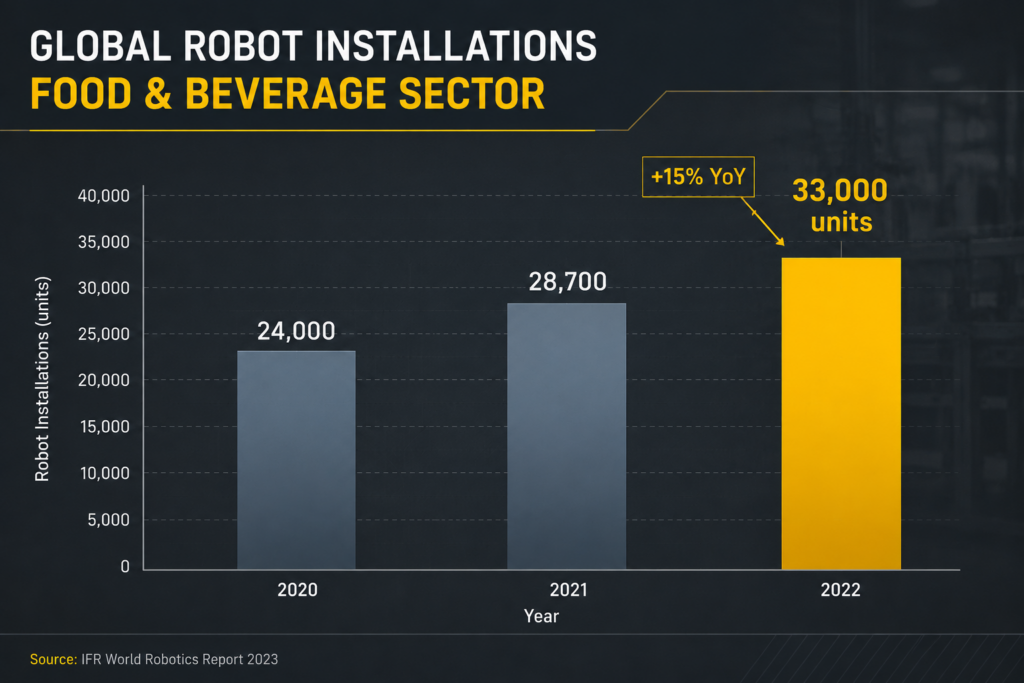
Global industrial robot installations in the food and beverage sector reached approximately 33,000 units in 2022, representing a 15% year-over-year increase.
Food and beverage is now one of the fastest-growing robot deployment sectors globally, driven largely by packaging and palletizing automation. If your competitors are adopting at this rate, a wait-and-see approach has a real cost.
SOURCE: International Federation of Robotics (IFR), World Robotics Report 2023
End Effectors: The Part That Actually Touches Your Product
The robot arm is generic hardware. The end effector is where the application lives, and it’s usually the component most underspecced in early project planning.
For packaging, the dominant tooling types are vacuum cup grippers (for flat, smooth surfaces), mechanical finger grippers (for irregular shapes or bags), and magnetic grippers (for metal cans or steel components). Most packaging applications use vacuum , either foam-tipped cups for delicate products or bellows cups for uneven surfaces.
Vacuum flow rate and cup area are the specs that matter most. A gripper that works on a 500g snack pouch at 30°C will fail on the same pouch at 5°C in a cold chain facility because the material stiffens and the seal degrades. Always spec your vacuum gripper for the worst-case product condition, not nominal.
Dual-zone vacuum tooling , where you can actuate subsets of cups independently , lets one tool handle multiple SKU sizes without a tool change. This is worth the upfront cost on any line running more than three product sizes. Tool changers (ATI Robotics makes reliable ones) are the alternative if SKUs vary dramatically in shape or weight.
Gripper weight matters more than most people expect. Every kilogram of tooling you add reduces your effective payload. A UR16e with a 4 kg vacuum gripper only has 12 kg of effective payload left , and that’s before you factor in cable management and acceleration loads.
Deployment: What a Real Rollout Looks Like
I’ll say this plainly: the robot is rarely the longest lead-time item in a packaging automation project. It’s the cell design, the safety validation, the PLC integration, and the operator training.
A realistic timeline for a mid-complexity packaging cell , two robot arms, conveyor integration, vision, safety fencing , runs 16 to 28 weeks from PO to production-ready. Any integrator quoting 8 weeks on that scope is either leaving out commissioning time or hasn’t done it before.
Phased rollouts work well in packaging. Start with palletizing (highest ROI, lowest integration complexity), prove the ROI internally, then expand to case packing or pick-and-place. You’ll also have a trained maintenance tech by the time you tackle the harder integration.
Budget 10-15% of the total cell cost annually for maintenance: consumables like vacuum cups and filter elements, annual calibration, and software licensing for vision systems. Skipping this budget line is how facilities end up running degraded systems for months without realizing throughput has dropped 20%.
Browse available industrial robot arms and packaging automation hardware at the factoryrobots.net shop , full specs and pricing on every listing, no quote form required.
Key Takeaways
- Palletizing offers the fastest ROI entry point for most facilities , start there before tackling full-line automation.
- Cobot packaging makes sense for flexible, low-throughput tasks; don’t use a UR arm where an industrial palletizer is actually needed.
- Always spec vacuum gripper performance at worst-case product conditions , temperature, surface texture, and weight at full acceleration.
- Budget 16-28 weeks for a real packaging cell deployment; integrators quoting less are skipping commissioning.
- Vision system lighting is the most common source of false rejects post-commissioning , control it at the cell level, not the facility level.
Frequently Asked Questions
What is the ROI timeline for robotic packaging systems? Most palletizing installations break even in 12-24 months depending on labor cost and shift structure. Full secondary packaging cells with vision and case packing typically run 24-36 months to payback. The calculation shifts significantly if you’re running three shifts or paying overtime premiums.
Can a cobot handle full production packaging speeds? For most high-volume lines, no. Collaborative robots run power-and-force limiting modes that cap TCP speed to 250 mm/s in shared workspaces. If your line runs above 12-15 cartons per minute, you need an industrial arm with proper guarding , not a cobot without a cage.
What end effector should I use for flexible pouches and bags? Bellows-style vacuum cups with soft foam sealing lips work best for flexible packaging. For very lightweight films or pouches with minimal flat area, Bernoulli (non-contact) grippers are an option. Always test at temperature range extremes , cold chain applications regularly cause vacuum failures that weren’t visible at room temperature.
Do robotic packaging cells require a dedicated PLC or can they run off the robot controller? For simple single-arm cells, the robot controller (FANUC R-30iB, KUKA KR C5) can handle basic I/O and conveyor coordination. The moment you add vision, multiple robots, safety zones, or MES connectivity, you need a dedicated safety PLC. Rockwell ControlLogix and Siemens S7-1500 are standard choices in most North American and European facilities respectively.
Getting Your Packaging Line Running
Robotic packaging systems aren’t complicated in concept. The complexity is in the details: payload at acceleration, vision lighting, safety zone cycle-time impact, and gripper performance under real production conditions. Get those four things right and the rest of the integration follows a predictable path.
If you’re at the spec stage, start by locking down your cycle time requirement, your product’s worst-case dimensions and weight, and your safety zone layout. From there, the robot selection is almost mechanical. Explore the full range of hardware options , with specs and pricing listed directly, at factoryrobots.net.