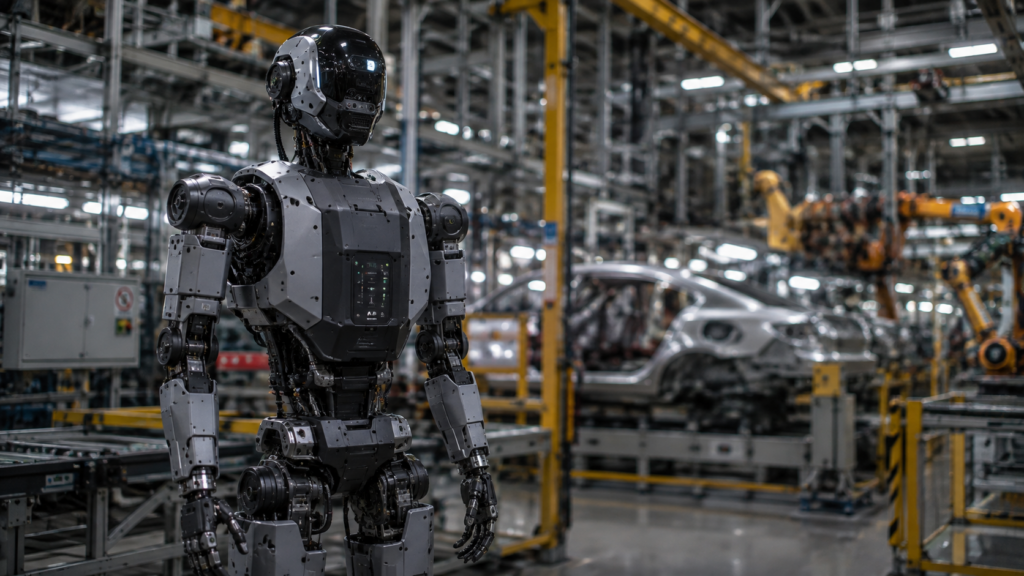
You’ve watched the demos. A humanoid robot walks across a stage, picks up a box, waves at the crowd. Impressive. Now you need to figure out if it can actually survive a 10-hour production shift, integrate with your WMS, and justify its line item on a capital expenditure form.
The humanoid robot market has matured faster than most people expected. There are real machines available for purchase right now , not vaporware, not research prototypes locked behind NDAs. But the gap between “demo-ready” and “deployment-ready” is still significant, and a lot of buyers are getting burned by specs that look good on a PDF and fall apart on the floor.
Here’s what to actually evaluate before you spend six figures on a humanoid robot for sale.
—
Degrees of Freedom: The Number That Actually Matters First
When you’re looking at humanoid robots for sale, the first spec most people fixate on is height or payload. Both matter. Neither is where you should start.
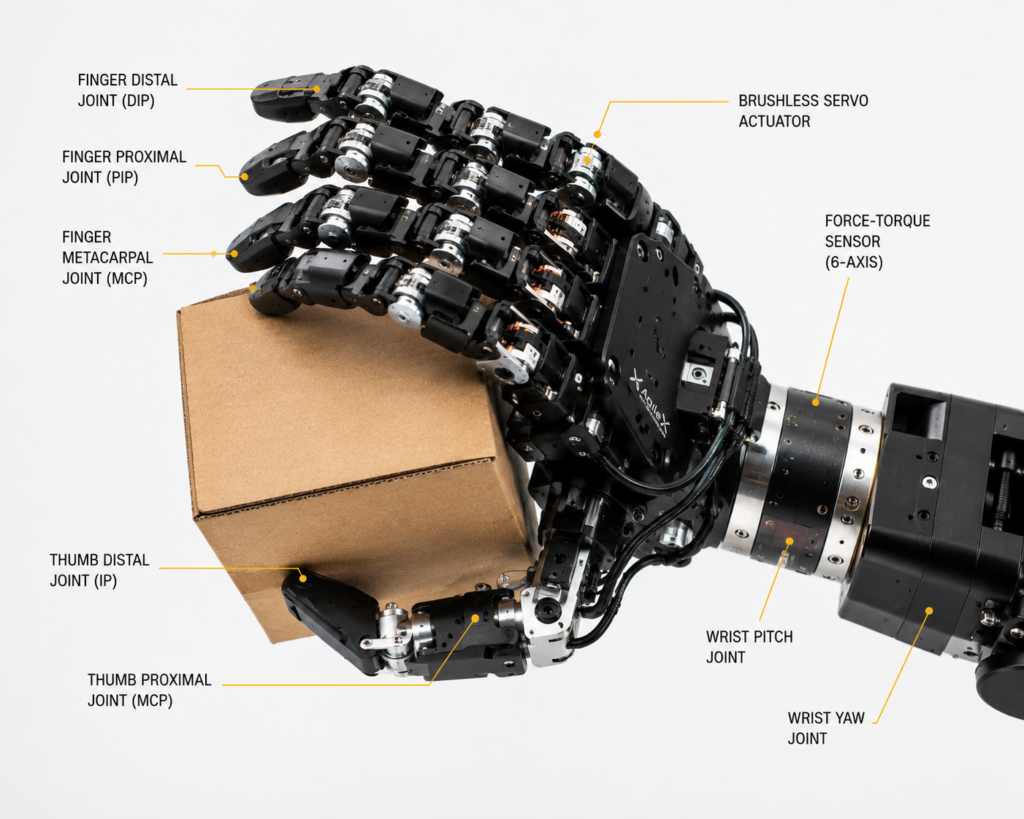
Degrees of freedom (DOF) is the real gating spec. It tells you how many independent axes of motion the robot has across its full body. A humanoid with 20 DOF in its arms and hands alone can manipulate objects in ways a 12-DOF system simply cannot reach , literally and figuratively.
The current benchmark for serious manipulation tasks is around 40–50 total DOF across the full body. Agility Robotics’ Digit sits around 20 DOF (simplified for logistics), while Figure’s Figure 02 and Apptronik’s Apollo are pushing closer to 40+ with dexterous hands. Tesla’s Optimus Gen 2 claims 22 degrees of freedom in the hands alone.
What does this mean practically? If your task involves picking items from unstructured shelving , mixed orientations, varied packaging, irregular weights , you need dexterous hands. If you’re moving totes in a warehouse with fixed pick points, fewer DOF may be fine and will almost certainly be more reliable.
Don’t let a vendor sell you 40 DOF if your task needs 25. More joints mean more failure points, more calibration time, and more software complexity. Match DOF to task requirements, not to spec sheet ego.
I’ve seen facilities get talked into high-DOF systems for simple pallet transfers. Three months in, they’re managing actuator failures weekly because they’re running joints that were never needed in the first place.
Payload, Cycle Time, and the Specs Vendors Bury in Footnotes
Payload for humanoid robots is measured differently than traditional robot arms, and this trips up a lot of procurement teams. A robot arm payload is rated at the end effector under defined conditions. Humanoid payload specs often refer to carried load , what the robot can hold against its body or move in a bipedal carry posture , which is not the same as manipulated payload.
Ask specifically: what is the single-arm end-effector payload at full reach? What is it at 50% reach? These numbers drop fast. A humanoid rated at 15 kg carried load might only reliably manipulate 3–5 kg at arm’s length without affecting stability.
Cycle time matters just as much as payload. A robot that can lift 10 kg but takes 45 seconds per pick cycle isn’t competitive with a fixed arm that cycles in 8 seconds on the same task. For most light assembly and pick-and-place tasks, you’re looking for humanoid cycle times in the 8–15 second range to be economically viable against traditional automation.
The first time I saw this spec buried was in a demo reel where cycle times were measured on a flat, clear surface with pre-positioned parts. On an actual cluttered warehouse floor? Times doubled. Always ask for cycle time data from a pilot deployment, not a demo environment.
Battery runtime is another area where marketing math diverges from operational reality. A “4-hour battery” at nominal load often means 2.5 hours under actual task conditions with full manipulation cycles. For continuous operations, you need either hot-swap battery capability or a charging rotation strategy , and that affects your total fleet size calculation.
—
Software Stack: What Runs the Robot When Things Go Wrong
Hardware gets the headlines. Software is what determines whether a humanoid robot for sale actually stays deployed after week three.
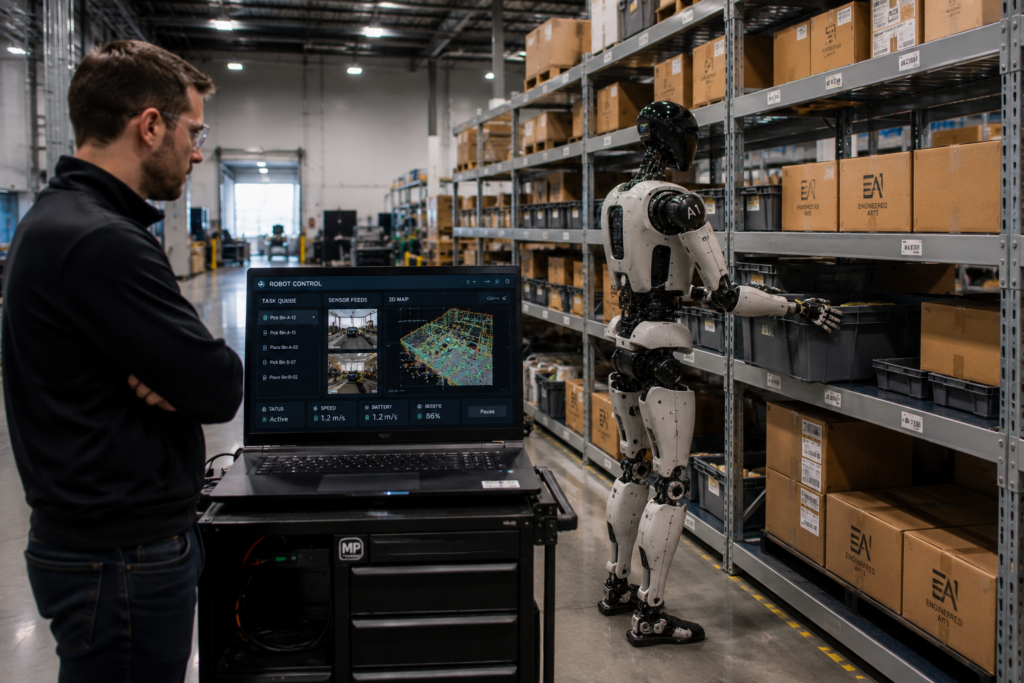
The critical question is: what’s the autonomy model? Most current commercial humanoids operate somewhere on a spectrum from teleoperation (human drives it remotely) to supervised autonomy (robot runs tasks, flags edge cases to human) to full autonomy (robot handles variance on its own). Very few are truly fully autonomous in unstructured environments.
Understand exactly where on that spectrum the robot operates for your specific task. A system sold as “autonomous” for warehouse picking may still require human review for 15–20% of picks. That’s not a failure , it’s a real operational requirement you need to staff and plan for.
Check what the robot runs on: Is it a proprietary closed stack, or does it expose APIs for integration? Can you connect it to your ERP or WMS? ROS2 compatibility is a positive signal for integrators , it means the vendor is building on a framework with real tooling and community support rather than a black box you can’t debug.
Also check: how are software updates handled? Over-the-air updates that can change behavior mid-deployment without your sign-off are an operational risk. You want version control over your fleet’s software, not automatic pushes from a vendor you don’t control.
Safety Certifications and What They Actually Cover
This is the section most buyers skip until something goes wrong. Don’t be that buyer.
For humanoid robots operating in shared human spaces , which is the entire value proposition of the form factor , safety certification is non-negotiable. Look for compliance with ISO 10218 (industrial robot safety) and, for collaborative operation, ISO/TS 15066, which defines contact force limits and speed/separation monitoring requirements.
The EU Machinery Directive and OSHA’s general duty clause in the US both impose requirements that will land on your safety team regardless of what the vendor claims. If a vendor can’t hand you a CE Declaration of Conformity or equivalent for your jurisdiction, that machine isn’t going into your facility , or it shouldn’t be.
Force sensing at the joints is a baseline safety requirement for any humanoid working near humans. Check the contact force limits: ISO/TS 15066 sets body-region-specific limits, some as low as 35N for sensitive areas. A humanoid with 60 kg of moving mass needs active force limiting that can respond in under 100ms to stay inside those limits.
You can review the ISO/TS 15066 standard directly through the ISO standards catalog , it’s worth reading the summary even if you don’t purchase the full document.
Don’t let a vendor wave at “CE marked” as a catch-all. Ask which specific standards were assessed, by which notified body, and when. Standards evolve, and a certification from three years ago may not reflect current requirements for humanoid-specific operation.
Total Cost of Ownership: The Number That Kills Most Justifications
A humanoid robot priced at $150,000 sounds like a lot until someone asks what it costs to own for three years. That’s where deals fall apart , or get approved.
Total cost of ownership (TCO) for a humanoid includes: purchase price, integration labor, ongoing software licensing (many vendors charge annual fees), replacement parts for high-wear components like actuators and end effectors, downtime costs, and training.
Actuator replacement is the sleeper cost. Humanoid robots have significantly more actuated joints than a traditional arm. Each joint is a potential failure point, and proprietary actuators from newer vendors can run $800–$2,000+ per unit. A full arm with 7 DOF has seven actuators. Do the math before you sign.
For a realistic TCO model, the Association for Advancing Automation (A3) has published guidance on cobot and flexible robot justification frameworks , their economics resources are a useful starting point for structuring your business case.
If you’re evaluating multiple humanoid platforms side by side, the compare tool at factoryrobots.net lets you pull specs and pricing across models without chasing down individual vendor quotes.
Budget for integration labor at 30–50% of hardware cost on your first deployment. It almost always runs that way. The second deployment on the same task will be faster and cheaper , but plan for a full integration effort on the first one.
—
Key Takeaways
- Match DOF to your actual task , more joints mean more failure points, not more capability for simpler applications.
- Always ask for end-effector payload at full reach, not carried load , the numbers are very different and vendors rarely volunteer the distinction.
- Verify software autonomy level and API access before purchase , “autonomous” covers a wide range of operational realities.
- Confirm specific ISO 10218 and ISO/TS 15066 compliance with documentation, not just a CE marking reference.
- Budget TCO at 1.5–2x hardware cost over three years, and plan integration labor at 30–50% of hardware cost for the first deployment.
—
Frequently Asked Questions
What is a realistic price range for a humanoid robot for sale in 2024? Commercial humanoid robots currently range from roughly $70,000 to $250,000 depending on DOF, autonomy level, and vendor. Figure, Agility, and Apptronik are all in active commercial deployment conversations in the $150,000–$200,000+ range. Prices are expected to drop as manufacturing scales, but don’t plan your ROI around future price reductions.
Can humanoid robots work alongside humans without safety caging? Some can, under specific conditions defined by ISO/TS 15066 , but this requires proper risk assessment, validated force-torque sensing, and speed/separation monitoring. It’s not automatic just because the robot is humanoid-shaped. Get a formal risk assessment from a qualified integrator before removing any guarding.
What tasks are humanoid robots actually deployment-ready for today? Light logistics (tote moving, case picking), inspection tasks, and simple assembly in structured environments are the current sweet spot. Unstructured manipulation, fine assembly with small parts, and outdoor operation are still maturing. Be skeptical of vendors claiming readiness for tasks outside this range without pilot data.
How long does it take to deploy a humanoid robot in a production environment? Plan for 3–6 months from purchase order to stable production for a first deployment. That includes integration, task programming, safety validation, and operator training. Vendors who promise faster timelines are either simplifying the task scope significantly or underestimating your environment’s complexity.
—
Making a Smart Buy on Your First Humanoid Deployment
The humanoid robot market is real, the hardware is deployable, and the economics are starting to work , but only if you buy the right machine for the right task with eyes open on TCO and integration complexity.
Start with your task requirements: cycle time, payload at reach, environment structure, and safety zone requirements. Let those numbers filter the market. Then dig into software stack, certification documentation, and actuator serviceability before you get attached to any specific platform.
Browse the current humanoid robots available for purchase , with full specs and pricing , at factoryrobots.net/shop/. No quote forms, no sales calls , just the specs you need to make a real decision.