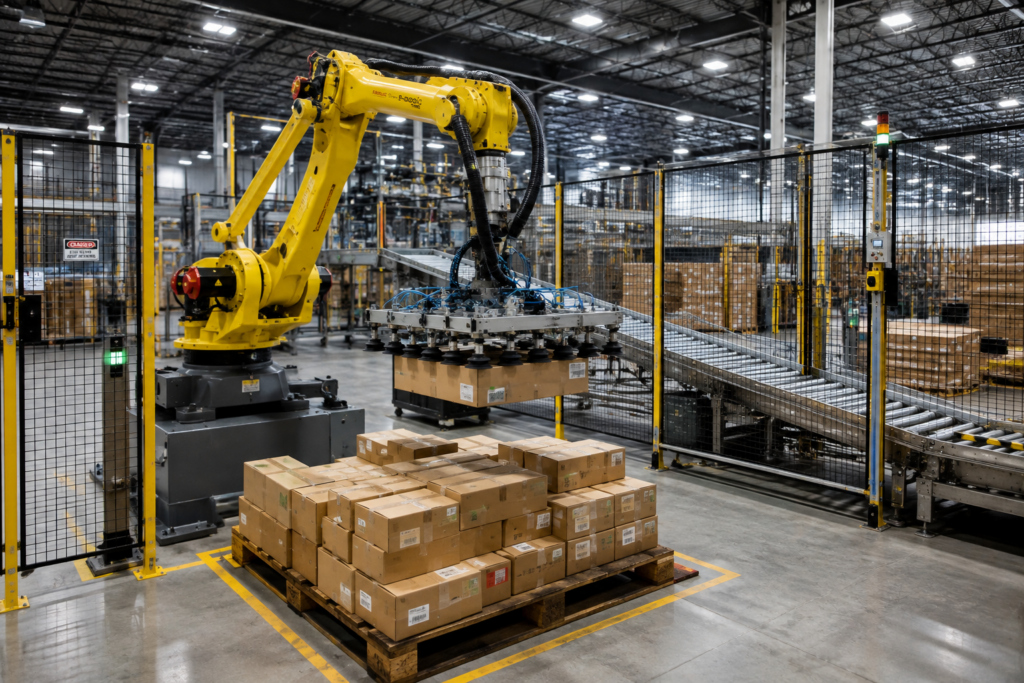
You’ve got a forklift dropping 40 pallets a shift at your inbound dock. Your team is manually breaking them down, cases stacked five layers high, mixed SKUs, inconsistent weights. Someone calls in sick on a Tuesday and the whole line backs up.
This is the problem depalletizing robots solve. Not someday, not in a pilot program. Right now, in distribution centers and manufacturing plants running three shifts a day.
The challenge isn’t whether a robot can do this. Modern systems handle it well. The challenge is picking the right configuration for your load type, throughput target, and floor layout. Get that wrong and you’ve bought a $200,000 machine that runs at 60% efficiency because nobody thought through the vision system or the conveyor interface.
This guide covers what actually matters when you’re speccing and deploying a depalletizing robot.
What a Depalletizing Robot Actually Does
A depalletizing robot picks cases, bags, or other unit loads off an incoming pallet and places them onto a conveyor, sortation system, or staging area. That sounds simple. The mechanics get complicated fast.
The core system is a robot arm, almost always an articulated 6-axis model with a reach of 2.0 to 3.5 meters, paired with an end effector and a vision system. The arm needs enough reach to get to the far corner of a 48×40-inch pallet at floor level, then deposit the case at conveyor height without a death-spiral path through the robot’s singularity. That geometry alone eliminates a lot of SCARA and delta configurations from consideration.
Payload matters more than most engineers expect. A single case of bottled water runs 40 lbs. Pick up two of those at once and you need an arm with a 50+ kg payload rating. The FANUC R-2000iC/165F and KUKA KR 210 are workhorses in this space for that reason, both handle real-world payloads in the 150-200 kg range when you factor in the gripper weight, which can add 20-30 kg by itself.
The vision system is what separates a depalletizer from a pick-and-place fixture. Mixed-SKU inbound pallets mean every pick is different. A 3D vision system, typically structured light or time-of-flight, builds a point cloud of the pallet and tells the robot where each case edge is, what angle it’s sitting at, and which layer it’s on. Without accurate vision, your robot stalls waiting for a human to straighten a tilted case.
Don’t underestimate cycle time math. Most operations need 600-1,200 cases per hour to justify the capital. At that rate you’re looking at 3-5 seconds per pick, including travel, grip, and place. Push faster than that and your conveyor downstream becomes the bottleneck.
Choosing the Right End Effector for Your Load Type
The end effector makes or breaks a depalletizing cell. Get this wrong and you’ll spend months in production trying to tune around a bad decision.
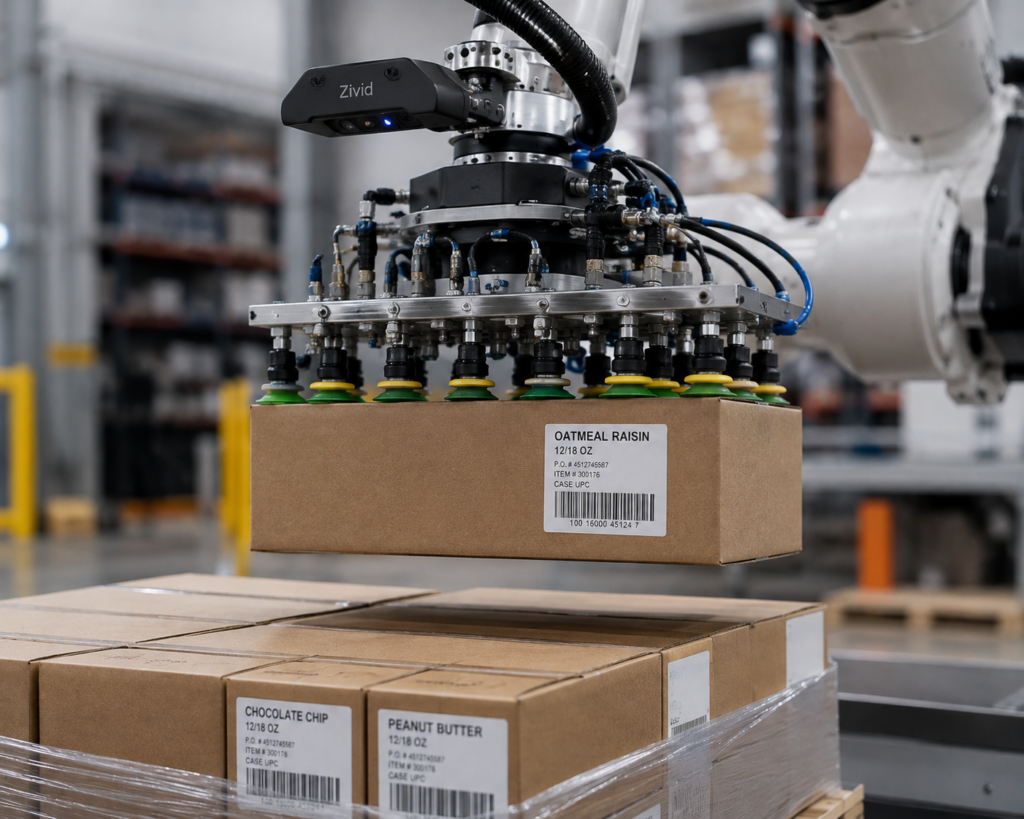
Vacuum grippers are the default choice for cardboard cases, smooth, flat surfaces grip well, and a multi-zone vacuum cup array lets you handle varying case sizes without retooling. Most systems run 4-8 suction cups arranged in a rectangular pattern. You’ll want a cup size matched to your smallest case so you don’t overhang and lose vacuum seal on mixed-size loads.
Bags, sacks, and flexible packaging are where vacuum grippers fail. A 50 lb bag of dog food deforms under the cup and bleeds vacuum. For those loads you’re looking at clamp grippers or fork-style end effectors that cradle the load from the sides or bottom. Some high-end systems use hybrid grippers with both vacuum and mechanical clamping, useful if you’re running multiple product types on the same cell.
Foam and fragile goods need pressure-limited grippers with force feedback. A standard vacuum gripper pulling full vacuum on a foam block or a case of eggs will crush the product. Force-sensing end effectors let you dial in grip pressure per SKU.
One thing I’ve seen trip up more deployments than any other single factor: end effector weight budgets. You spec a robot at 150 kg payload, then spec a vacuum gripper with integrated 3D camera, air manifold, and quick-change coupling. That gripper comes in at 35 kg. Now you’ve got 115 kg of real working payload, which is still fine for most cases but limits your ability to double-pick heavier loads. Always spec your effective payload after the gripper, not before.
If your load types vary significantly by shift or product family, consider a quick-change end effector system. The downtime for an end effector swap runs 3-5 minutes on a good quick-change coupling. That’s manageable. An hour with a wrench is not.
Vision Systems and Pallet Destack Logic
This is where most integrators earn their fee, or don’t.
A depalletizing vision system needs to solve a harder problem than standard bin-picking. The cases on an inbound pallet aren’t in a controlled position. They’re leaning, gap-shifted, sometimes wrapped in stretch film that reflects structured light and blows up your point cloud. The pallet itself is usually on the floor, which means the 3D camera is looking down at an angle and the geometry changes as layers are removed.
The two common approaches are fixed overhead cameras (mounted on a gantry or ceiling structure above the cell) and wrist-mounted cameras (mounted directly on the robot’s tool flange, moving with the arm). Overhead cameras give you a full pallet view in one shot, which is faster for layer-by-layer planning. Wrist-mounted cameras give you a closer, more accurate scan of the current pick zone before each grasp, which helps with irregular or deformed cases.
Most production systems use both: an overhead camera for macro pallet mapping and layer planning, a wrist camera for grasp refinement on each pick. That combination adds cost but cuts stall rates dramatically.
The software running on top of the vision data is the real differentiator. Systems from Mujin, RightHand Robotics, and Fizyr have invested heavily in pallet destack algorithms that handle mixed SKUs, random layer patterns, and damaged cases with much higher success rates than standard robot OEM vision packages. If your integrator is proposing to run depalletizing on a stock FANUC iRVision system without any add-on perception software, push back on that.

Cell Layout and Conveyor Integration
The robot is 20% of the problem. The other 80% is everything around it.
A depalletizing cell needs: pallet infeed (usually forklift or AGV), a stable robot base, a case outfeed conveyor, and somewhere for the empty pallet to go. Each of those handoffs is a potential stall point. I’ve watched cells run at 55% efficiency because nobody designed the empty pallet removal step and operators were pulling empties by hand while the robot waited.
Pallet infeed conveyor chains that index pallets into position are cleaner than forklift drops, the pallet position is consistent, which means the robot doesn’t have to compensate for a 6-inch variation in drop position. If your operation runs AGVs for inbound transport, integrating the AGV stop position with the robot cell controller gives you near-perfect pallet placement repeatability.
Conveyor height at the case outfeed is almost always 34-36 inches to match standard sortation systems. Make sure your robot arm’s working envelope covers the pallet pick zone and the conveyor drop zone without requiring awkward shoulder-up postures that slow cycle time. Simulate this in RobotStudio or ROBOGUIDE before you finalize the cell footprint.
Cell footprint is a real constraint in most plants. A standard depalletizing cell with a 2.5m reach robot, safety fencing, pallet infeed/outfeed, and a stretch wrap removal station runs roughly 20×25 feet. That’s before you account for forklift access lanes on at least two sides.
For operations integrating with existing warehouse management systems, the robot controller needs to accept pallet manifest data, what SKU, how many layers, case weight, from your WMS to pre-configure the pick strategy. Most modern robot controllers handle this via a REST API or OPC-UA connection. Confirm this before you sign a purchase order, not after.
Warehouse Robot Installations Growth Chart
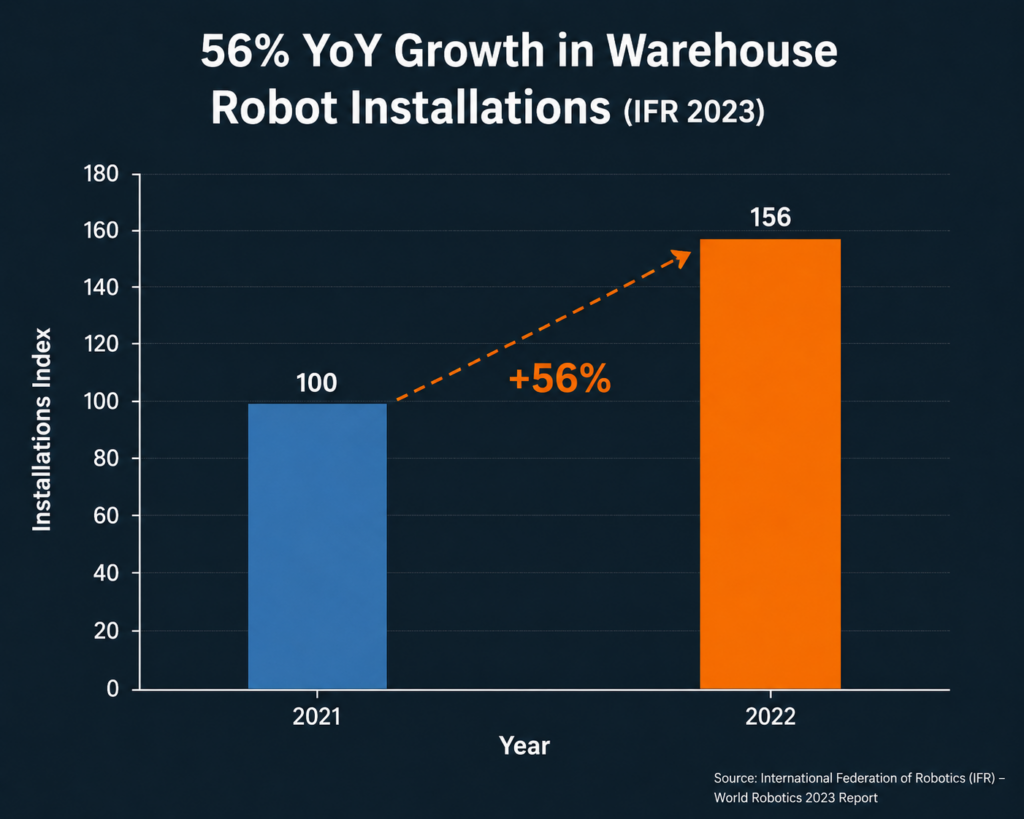
Global industrial robot installations in logistics and warehousing grew 56% year-over-year in 2022, with palletizing and depalletizing applications representing one of the fastest-growing use cases.
That growth rate means the technology, the integration playbooks, and the vendor ecosystem are all maturing quickly. Systems that required custom software builds three years ago are now productized. For operations engineers evaluating depalletizing, the total integration risk is significantly lower today than it was even in 2021.
SOURCE: International Federation of Robotics (IFR), World Robotics Report 2023
Safety, Standards, and What Your Insurance Auditor Will Ask About
Depalletizing cells are high-energy environments. A 200 kg robot arm moving at full speed with a 40 kg payload is a machine that kills people if the safety architecture fails.
The governing standard is ISO 10218-1 and ISO 10218-2, covering industrial robot safety requirements and integration requirements respectively. Your integrator is required to perform a risk assessment per these standards before the cell goes live. If they’re not referencing these in their integration documentation, that’s a red flag. The full ISO 10218-2 standard is available directly from the ISO standards catalog.
Perimeter guarding, hard fencing, light curtains, or a combination, is required. Light curtains at entry points allow personnel access without full cell shutdown, which matters for pallet changeouts. Area scanners from SICK or Keyence give you configurable safety zones that can slow the robot rather than stop it when someone enters a buffer zone, which helps maintain throughput during supervised access.
For collaborative depalletizing cells using robots like the Universal Robots UR20 (20 kg payload, not suitable for full case depalletizing but useful for light-load mixed applications), the safety architecture shifts to speed and separation monitoring rather than hard guarding. That’s a different risk assessment methodology covered under ISO/TS 15066, the technical specification for collaborative robot applications.
Document your risk assessment, your safeguard choices, and your operator training records. When your insurance auditor or an OSHA inspector walks in, those three documents are what they ask for first.
Key Takeaways
- Match your robot payload to the heaviest double-pick you’ll ever make, including gripper weight, not just the case weight alone.
- A 3D vision system is non-negotiable for mixed-SKU inbound pallets; budget for perception software on top of the base robot OEM vision package.
- Design the empty pallet removal flow before you finalize your cell layout, it’s the most commonly overlooked stall point in depalletizing cells.
- Confirm WMS integration protocol (REST API or OPC-UA) with your robot controller vendor before purchasing, not during commissioning.
- Reference ISO 10218-1/2 in your risk assessment and keep training records current, these are the first documents an OSHA inspector or insurance auditor will request.
Frequently Asked Questions
What’s the difference between a palletizing robot and a depalletizing robot? A palletizing robot builds pallet loads, stacking cases in a defined pattern from a conveyor onto an outbound pallet. A depalletizing robot does the reverse: unloading cases from an inbound pallet onto a conveyor or staging area. The mechanical hardware often overlaps, but the vision and software requirements for depalletizing are more complex because inbound pallet loads are typically less organized than outbound ones your own system built.
How fast can a depalletizing robot pick cases? Most production depalletizing systems run 600 to 1,200 cases per hour depending on case size, weight, and consistency. That translates to roughly 3-6 seconds per pick cycle including vision scan, arm travel, grip, and place. Double-picking (picking two cases simultaneously) can push throughput higher but requires a wider end effector and a higher payload robot.
Can a depalletizing robot handle mixed-SKU pallets? Yes, but it requires a capable 3D vision system and robust pallet destack software. Systems using add-on perception packages from vendors like Mujin or Fizyr handle mixed-SKU inbound pallets in production environments today. The key variable is how irregular your case sizes are, tightly constrained SKU ranges (e.g., all standard FMCG cases) are significantly easier to handle than extreme variety with bags, odd shapes, and non-rigid packaging.
What robot brands are most commonly used for depalletizing? FANUC, KUKA, ABB, and Yaskawa Motoman dominate the installed base for depalletizing applications. The FANUC M-410 series and KUKA KR QUANTEC series are particularly common in food, beverage, and distribution applications due to their payload range (120-700 kg), long reach, and the maturity of their vision integration options. For lighter-duty applications under 25 kg per case, some integrators use Universal Robots UR20 in semi-collaborative configurations.
Start Speccing Your Depalletizing Cell
If you know your throughput target (cases per hour), your heaviest case weight, and whether your inbound pallets are single-SKU or mixed, you have enough to start a serious conversation about robot and end effector selection.
The rest, cell layout, vision system, conveyor integration, follows from those three numbers. Browse available palletizing and material handling robot arms at factoryrobots.net with full specs and pricing listed, no quote form required. If you need help working through integration requirements, our engineering support team is at factoryrobots.net/support/.