
You’ve been told cobots are the easy button for automation. Drop one in, hit start, let it run. I’ve seen that pitch from every vendor at every trade show for the past decade. It’s not wrong exactly , cobots genuinely are easier to deploy than traditional industrial robots. But “easier” and “easy” are very different words, and conflating them is how plants end up with a $35,000 cobot arm sitting idle next to a line because nobody accounted for cycle time, payload, or process variability. This guide is the one I wish existed before my first deployment. We’ll cover what cobots actually do well, where they fall apart, and how to size your expectations before you cut a purchase order.
What Makes a Robot a Cobot
Collaborative robots, or cobots, are robot arms designed to operate in close physical proximity to humans without traditional hard-guarded safety cells. That’s the core distinction. A standard articulated industrial arm , a FANUC M-20 or a KUKA KR 10 , requires a full safety enclosure with interlocked gates. A cobot like the Universal Robots UR10e or the Techman TM12 uses force-torque sensing, speed limiting, and sometimes vision to detect human presence and reduce speed or stop before making harmful contact.
ISO 10218-1 and ISO/TS 15066 are the two standards that actually define what collaborative operation means. If you haven’t read them, ISO/TS 15066 is freely summarized by the Robotic Industries Association and it’s worth your time before any deployment.
The collaborative designation applies to the operating mode, not just the hardware. A UR5e can be set up with a safety cage and run in standard mode at full speed , at that point it’s not operating collaboratively. The mode depends on your risk assessment and integration design, not the robot’s brand name.
Don’t confuse a cobot with a lightweight industrial arm. They overlap in payload range, but a lightweight arm doesn’t necessarily carry the sensor suite or safety-rated I/O needed to pass a collaborative operation risk assessment.
Real Cobot Applications in Manufacturing
The applications where cobots in manufacturing genuinely earn their keep tend to share a few traits: medium-frequency tasks, moderate precision requirements, variable product mix, and physical proximity to human workers that makes hard guarding impractical or expensive.
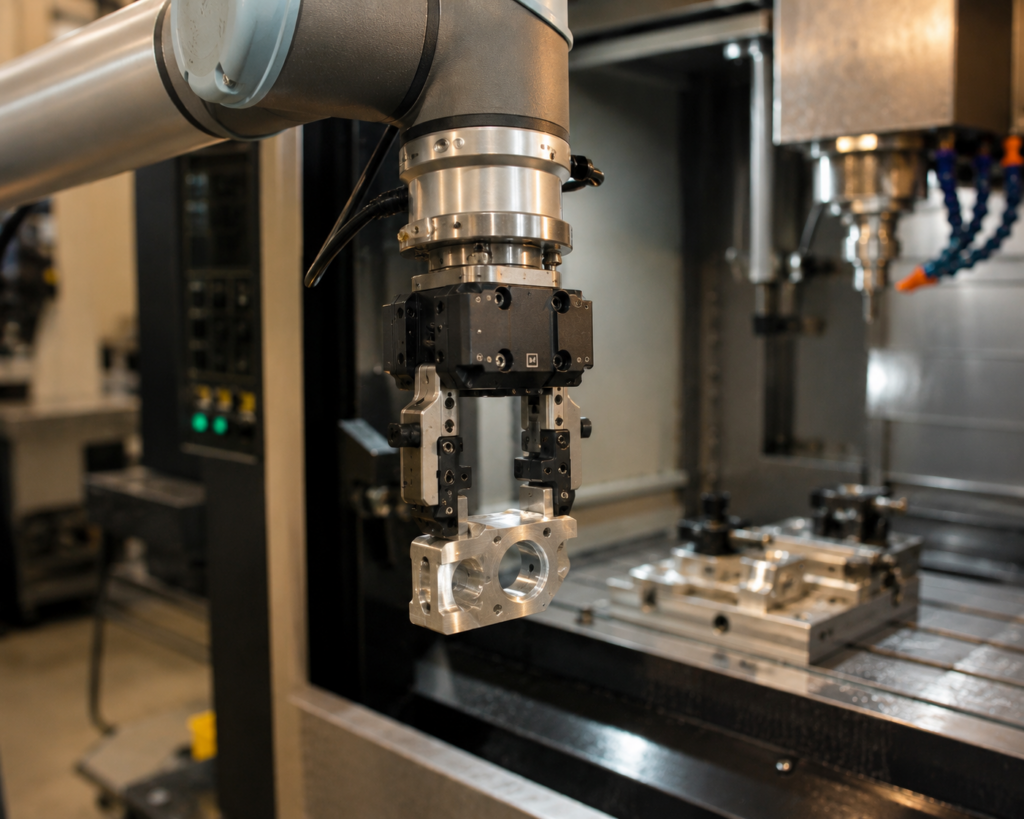
Machine tending is the most common deployment I’ve seen work well. A cobot arm loads blanks into a CNC lathe, waits for the cycle, unloads the finished part, and drops it on a conveyor. The UR10e handles this all day at 10 kg payload. Cycle times in the 20–60 second range are a sweet spot , fast enough to add value, slow enough that the cobot’s reduced speed in collaborative mode doesn’t become a bottleneck.
Assembly tasks are hit or miss. Simple two-part joins with compliant end effectors? Solid. Tight-tolerance press-fits or anything requiring more than about ±0.05 mm repeatability? You’ll fight it. The UR10e has ±0.05 mm repeatability spec, which sounds fine until thermal drift and worn tooling eat into that margin.
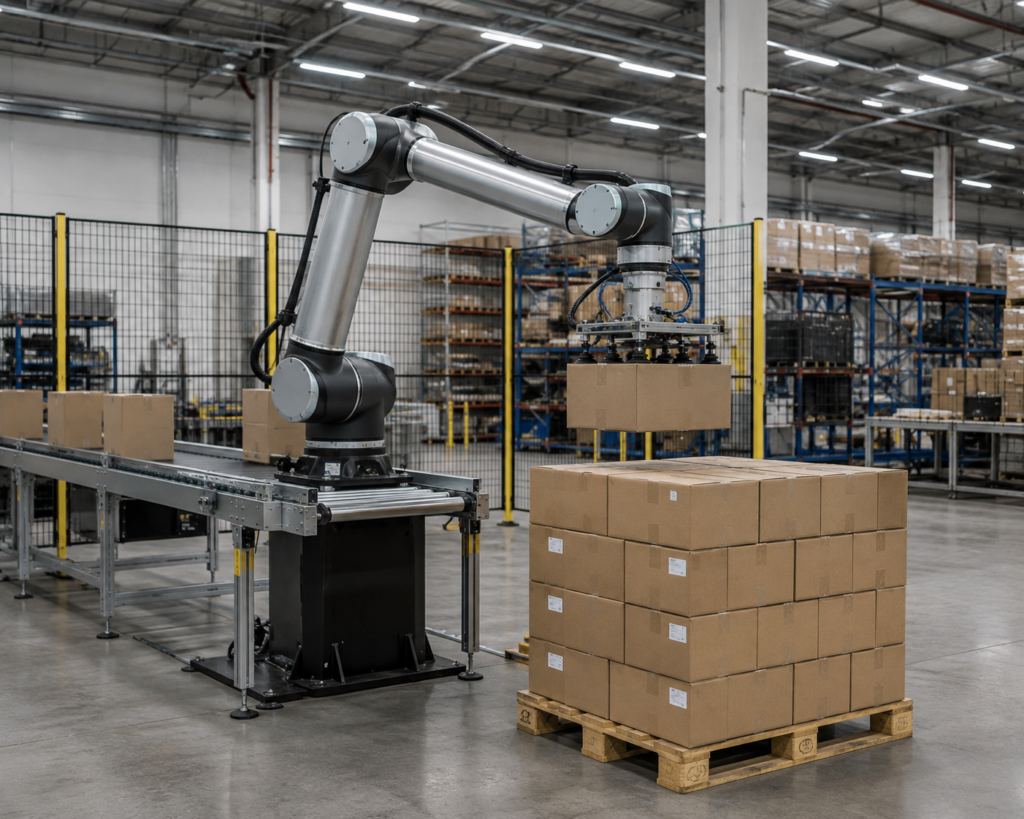
Palletizing is where palletizing cobots have carved out a serious niche. Low-mix, moderate-weight box stacking at end of line is exactly what something like the Universal Robots UR20 (20 kg payload, 1750 mm reach) or Doosan H2017 was built for. These aren’t glamorous deployments, but they work, they’re repeatable, and they free up workers from repetitive strain injury risk.
Quality inspection with integrated vision is growing fast. A cobot arm holding a camera over a part, rotating it through programmed poses, and feeding images to a machine vision system , that’s a real workflow and it plays to the cobot’s strength in slow, precise motion.
Where Cobots Fall Short
Here’s where I get less popular at vendor demos. Cobots have real limitations and glossing over them wastes your time and your budget.
Speed is the most common surprise. In collaborative mode under ISO/TS 15066, TCP (tool center point) speed is typically limited to 250 mm/s when a human could be in the space. Some deployments drop to 150 mm/s or less depending on the risk assessment. A standard industrial arm runs at 2000 mm/s or more. If your process needs fast cycle times , under 8 seconds, say , a cobot in true collaborative mode likely can’t compete. I’ve seen palletizing lines specified with cobots that ended up needing a safety cage anyway because the required throughput demanded full speed, at which point you’ve bought a slow industrial robot at a cobot price.
Payload drops off fast with reach. A UR10e is rated at 10 kg, but that’s at minimal reach. Extend to full 1300 mm and you’re looking at significant torque limits that reduce effective payload depending on the end effector geometry and part centroid. Always calculate your moment load at full extension, not just the headline payload number.
Process variability can break cobot deployments. A cobot loves a consistent feed. Put one on a line where parts arrive in random orientations from an upstream manual operation, and you need vision , which adds cost, complexity, and integration time. Without it, the cobot jams, misfires, or faults out.
Force sensing has limits too. Collaborative safety relies on the robot detecting unexpected contact force and stopping. But if your process involves push-fitting parts, the robot is intentionally applying force , which means the safety system has to distinguish between “intentional process force” and “I just hit a worker.” That’s a real configuration challenge and it requires careful safety programming, not just default settings.
Sizing a Cobot Arm for Your Application
Before you browse a cobot arm, three numbers define your shortlist: payload, reach, and repeatability.
Payload is the combined weight of your end effector plus the part at full extension. Be conservative. Add 20% margin as a floor. A 10 kg payload cobot carrying an 8 kg gripper-plus-part combo is working near its limit and you’ll see it in accuracy and long-term wear.
Reach needs to match your cell geometry. Sketch your workstation before you pick a model. The distance from the robot base to the furthest point it needs to touch , loading position, unloading position, conveyor drop point , defines minimum reach. If a UR5e (850 mm reach) fits the geometry and the payload is under 5 kg, don’t spec the UR10e just because the price difference seems small. The smaller arm will be faster and more accurate in that envelope.
Repeatability is what the manufacturer guarantees the robot can return to a taught point. It’s not accuracy , the robot’s ability to go where you command it cold. Most cobots are in the ±0.02 mm to ±0.1 mm repeatability range. For most assembly and machine tending that’s fine. For precision electronics or optical assembly, verify it against your actual tolerance stack-up.
Also check the cobot’s I/O options early. If you need to communicate with a Siemens S7 PLC via PROFINET, confirm the robot controller supports it natively or budget for a communication module. I spent weeks debugging a fieldbus mismatch on a first cobot integration before realizing the robot’s native EtherNet/IP support didn’t cover the PLC firmware version on site. That’s a painful lesson.
Deployment and Safety: What the Risk Assessment Actually Requires
A lot of teams assume “it’s a cobot, so it’s safe out of the box.” That’s not how ISO 10218 works. You still need a risk assessment. You still need to document hazards. The cobot’s safety-rated stop functions and force limits are tools you use in your risk mitigation , they don’t replace the assessment.
The practical steps: define the collaborative workspace (where human and robot can both be), set your TCP speed limits and force limits in the robot’s safety configuration, then validate with your actual tooling. A sharp gripper jaw changes your force-threshold math. A heavy end effector changes stopping distance.
The IEEE Robotics and Automation Society has published peer-reviewed work on human-robot collision injury thresholds that’s actually useful for understanding what the ISO/TS 15066 biomechanical limits are based on , worth reading if you’re doing a serious risk assessment.
Most cobot vendors offer safety configuration tools inside their teach pendants. Universal Robots’ safety PLC and Fanuc’s DCS (Dual Check Safety) both let you define speed, force, and workspace limits with safety-rated outputs. Use them. Don’t just leave defaults.
Operator Training Is Non-Negotiable
Every operator who will work in the collaborative zone needs training on what the robot does, what it doesn’t do, and what to do if it faults. “It’ll stop if it hits you” is not a training program. Run the robot through its safety stop scenario with the team present. Show them the force thresholds. Make sure they know how to initiate an e-stop and who to contact for faults.
Total Cost of Ownership Beyond the Robot Price
The robot arm is typically 40–60% of your total deployment cost. The rest is integration: end effector, mounting structure, controller wiring, safety configuration, programming, commissioning, and downtime during runoff.
For a typical machine tending cell: budget the robot at $30,000–$55,000 depending on payload and brand, then add $8,000–$15,000 for a quality gripper and tooling, $5,000–$10,000 for mechanical integration, and $10,000–$20,000 for programming and commissioning if you’re not doing it in-house. You’re looking at $55,000–$100,000 fully deployed. That math still makes sense for most applications , the ROI on a two-shift machine tending operation often hits under 18 months , but walk in with eyes open.
Maintenance is low on cobots relative to full industrial arms. Fewer axes under high dynamic load, no hard-guarded safety circuits to maintain, and simpler teach pendant programming mean lower ongoing cost. Annual calibration checks and joint inspection are still required , don’t skip them.
Key Takeaways
- Cobots operate collaboratively only when configured to ISO/TS 15066 , the hardware alone doesn’t guarantee compliance without a proper risk assessment.
- Payload at full reach is always lower than the headline spec , calculate moment load with your actual end effector and part centroid before finalizing a model.
- Machine tending, palletizing, and vision-guided inspection are the highest-success cobot applications in manufacturing; tight-tolerance assembly and high-speed cycle applications are where cobots most often underperform.
- Total deployment cost is typically 2x the robot price , budget for integration, tooling, and commissioning up front.
- Fieldbus and I/O compatibility between the cobot controller and your existing PLC architecture needs to be confirmed before purchase, not after delivery.
Frequently Asked Questions
What is the difference between a cobot and an industrial robot arm? A cobot is designed to work in close proximity to humans using force-torque sensing and speed limiting to prevent injury without a full safety enclosure. Traditional industrial robot arms operate at high speed inside hard-guarded cells and will not stop for a human entering the work zone. The distinction is the operating mode and safety architecture, not just the size or payload range.
What payload do I need for a palletizing cobot? For standard end-of-line box palletizing, most applications fall in the 10–20 kg payload range. The UR20 (20 kg) and Doosan H2017 (17 kg) are commonly deployed for carton weights up to 15 kg with a moderate gripper. Always confirm payload at the reach distance your cell geometry requires , headline specs are at minimal extension.
Do cobots require safety cages? Not necessarily, but they require a risk assessment that may still result in guarding requirements depending on your application. If your process uses a sharp tool, high process force, or requires full speed, guarding or light curtains may still be needed. “Collaborative robot” does not automatically mean “no guarding required.”
How long does it take to deploy a cobot in a manufacturing line? Simple machine tending deployments with a stable feed can be commissioned in 2–4 weeks from delivery. More complex cells with vision, multiple end effectors, or custom fixturing typically run 6–12 weeks. Programming time is significantly lower than traditional industrial robots, but integration complexity drives the real timeline.
Start With the Right Spec
The plants that deploy cobots successfully are the ones that did the work upfront , cell layout, payload calc, cycle time math, risk assessment, PLC compatibility check , before a robot ever shipped. Cobots in manufacturing are genuinely useful, high-ROI equipment when matched to the right task. They’re expensive paperweights when they’re not.
If you’re ready to spec your deployment, browse the full cobot and robot arm catalog at factoryrobots.net with full specs and pricing listed on every product. No quote forms, no sales calls , just the numbers you need to make the decision. Questions on integration or safety configuration? The engineering team at factoryrobots.net can help you work through the details before you commit.