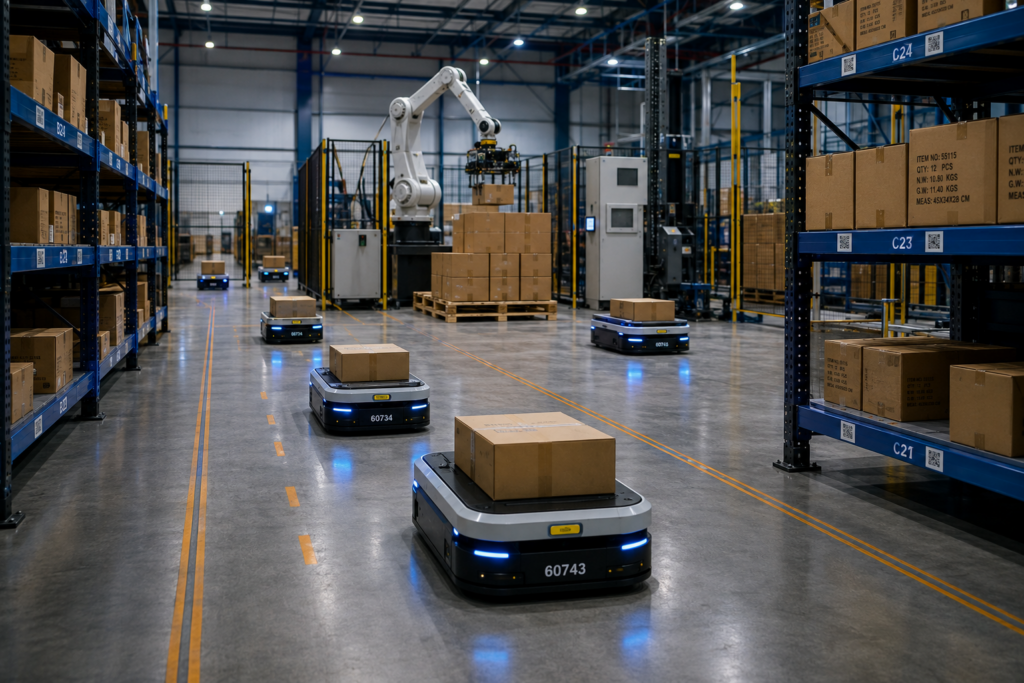
You’ve got a facility moving thousands of SKUs a day, and people are still pushing carts. Or you’ve got a legacy conveyor system that breaks down every third shift. Either way, you’re here because moving material by hand , or with outdated infrastructure , is costing you time, money, or both.
Automated material handling systems cover a wide range of hardware: AGVs, AMRs, robotic arms, conveyors, sortation systems, and more. The problem isn’t finding the technology. It’s knowing which system actually fits your floor, your throughput, and your budget. This guide cuts through the noise and gives you a practical framework for making that call.
What Counts as an Automated Material Handling System
Automated material handling refers to any technology that moves, stores, controls, or protects materials through a facility with minimal human intervention. That’s a wide definition, and intentionally so , because the category spans everything from a simple conveyor belt to a fleet of 50 AMRs running dynamic routing algorithms.
The major hardware categories you’ll actually encounter in modern manufacturing and distribution are fixed automation (conveyors, sorters, carousels), mobile automation (AGVs and AMRs), and robotic manipulation (robot arms, palletizers, depalletizers). Vision systems and warehouse management software sit underneath all of it as enabling infrastructure.
Most facilities end up combining two or three of these. A pure conveyor play made sense in the 1980s. Today, the smart builds layer mobile robots for flexible transport with fixed infrastructure for high-volume lanes and robot arms at the pick and pack stations.
The first mistake I see people make is treating these categories as interchangeable. An AMR doesn’t replace a conveyor. A conveyor doesn’t replace a palletizer. Understanding what each system is actually optimized for saves you from a six-figure deployment mistake.
AGVs vs. AMRs: The Distinction That Actually Matters
People use these terms interchangeably and they’re wrong. The difference is fundamental.
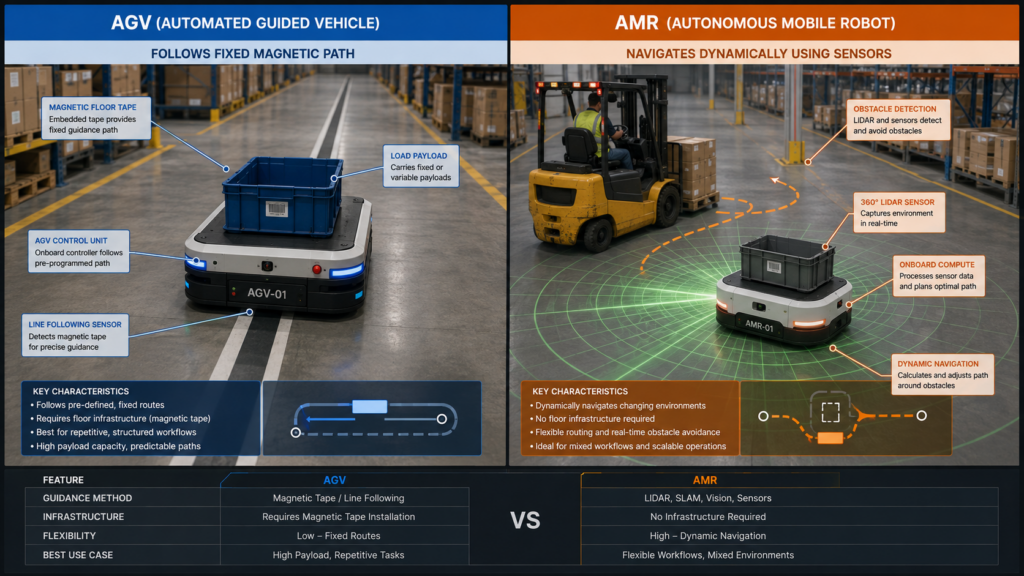
An AGV (Automated Guided Vehicle) follows a fixed path , magnetic tape, wire in the floor, laser reflectors, or similar infrastructure. It does one route, reliably, at scale. A AMR (Autonomous Mobile Robot) uses onboard sensors, cameras, and SLAM (Simultaneous Localization and Mapping) to navigate dynamically. It builds its own map, avoids obstacles in real time, and can reroute around a forklift parked in the aisle.
AGVs are cheaper per unit, simpler to maintain, and extremely reliable on defined routes. They’re the right call for high-volume, fixed-path workflows , towing carts between workstations, moving pallets between staging and dock doors. If your workflow doesn’t change much, an AGV will outperform an AMR on cost and uptime over a 10-year horizon.
AMRs shine in dynamic environments. E-commerce fulfillment with constantly changing pick locations, facilities that reconfigure seasonally, or any operation where blocking one aisle would dead-stop an AGV fleet. I’ve watched a four-AMR deployment from MiR outperform an eight-AGV system simply because the AGVs kept queuing at a single bottleneck and the AMRs just routed around it.
The specs to compare when evaluating either platform: payload capacity (kg), max speed (m/s), battery runtime and charge method (opportunity vs. full cycle), navigation type, fleet management software, and safety certification (ISO 3691-4 for industrial trucks covers most AGVs; AMRs typically comply with ISO 15066 for collaborative operation near people).
You can review side-by-side specs for AGVs and AMRs currently in stock at factoryrobots.net/shop/ without filling out a single form.
Robot Arms in Material Handling: Where They Fit and Where They Don’t
A mobile robot moves material between points A and B. A robot arm does something to material at a fixed station , picks it, places it, palletizes it, inspects it. These are different jobs.
In a material handling context, the most common robot arm applications are palletizing (stacking boxes onto pallets at end of line), depalletizing (breaking down inbound pallet loads), case erecting and packing, and bin picking for order fulfillment.
Palletizing is arguably the highest-ROI robot arm deployment in distribution. A FANUC M-410iC/185 can palletize at 2,100 cycles per hour with a 185 kg payload. A human palletizer doing the same job hits maybe 400-500 cycles per hour and files a workers’ comp claim after six months. The ROI math isn’t subtle.
For bin picking , pulling individual items from unstructured bins , you need a vision system integrated with the arm, and this is where a lot of deployments get complicated. Vision-guided picking is well-solved for structured environments (same SKU, known orientation), but mixed-SKU unstructured bin picking is still technically challenging. I’ve seen integrators promise it works and deliver 70% pick success rates that tanked a production line. Know your use case before you spec the hardware.
Reach (mm), payload (kg), repeatability (±mm), cycle time, and IP rating all matter. So does the end effector , the gripper, vacuum cup, or tooling that actually contacts the product. A robot arm is only as good as what’s on the end of it. For a detailed look at how to parse these specs correctly, the existing guide on reading robot arm spec sheets on the factoryrobots.net blog is worth your time.

Conveyor and Sortation Systems: The Infrastructure Layer
Conveyors aren’t glamorous, but underestimate them and you’ll have a beautiful robot fleet feeding into a manual bottleneck.
For high-volume, fixed-path transport , moving cases from induction to packing, routing totes between floors, feeding product to a robot arm , a conveyor is often the right call. It’s lower cost per unit throughput than mobile robots at scale, it doesn’t need charging, and a well-maintained belt conveyor runs for 20 years.
The design decisions that matter most: line speed (meters/minute), accumulation capability (can it buffer product without jamming?), sortation method (pop-up wheels, divert arms, sliding shoe sorters), and integration with your WMS or PLC.
Sliding shoe sorters are the workhorses of high-speed e-commerce fulfillment , capable of 200+ cartons per minute with accurate divert rates above 99.5%. The Dematic and Vanderlande systems running in large distribution centers are doing exactly this, though at price points that only make sense above a certain throughput threshold.
Where conveyors fall short: they can’t handle irregular items well, they’re infrastructure you can’t relocate easily, and a single failure point can stop an entire line. For facilities expecting layout changes within 3-5 years, heavy conveyor investment can become a liability. AMR material handling offers the flexibility that fixed conveyor infrastructure can’t.
According to ISO 22166-1:2021, functional safety requirements for industrial robots include collaborative operation standards that apply directly to how mobile robots interact with conveyor handoff zones , worth reviewing before you design an integration point. The full standard is available through the ISO standards portal.
Designing a System That Actually Works: Integration Principles
The hardware is the easy part. Integration is where projects succeed or fail.
The first time I saw a perfectly good AMR deployment fail, it wasn’t the robots. It was the WMS. The AMR fleet management system and the warehouse management system weren’t talking to each other in real time, so the AMRs were getting job assignments for locations that were already cleared. Half the fleet was running empty.
Every automated material handling system needs a clear data architecture before you order hardware. That means defining: what system assigns tasks (WMS, ERP, fleet management software, or MES), how status updates flow back from hardware to the warehouse management layer, how exceptions are handled (blocked path, failed pick, low battery), and who owns the integration work.
On the physical side: floor flatness matters more than most people expect. AMRs and AGVs spec floor flatness requirements , typically FF35 or better on the F-number scale, per ASTM E1155. A floor that’s fine for forklifts can cause navigation drift in an AMR. I spent weeks debugging inconsistent localization on a deployment before someone pulled out a level and found a 12mm grade change running the length of the dock area.
Power infrastructure, safety zoning (ANSI/RIA R15.08 covers AMR safety in the US), network coverage for fleet management, and maintenance access all need to be planned before hardware arrives. You can reach the engineering support team at factoryrobots.net/support/ for integration guidance specific to equipment you’re speccing.
The MHI (Material Handling Institute) publishes benchmark data on system integration lead times and common failure modes in automated warehouses , their annual industry report is a useful reference. Full access is available via the MHI research portal.
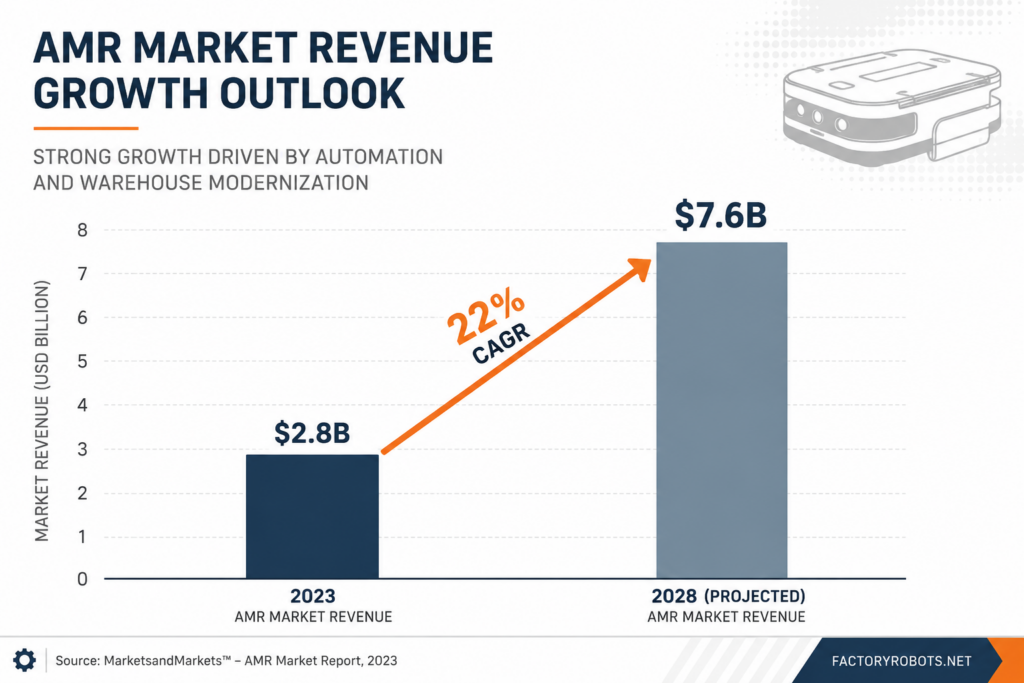
Global AMR market revenues reached $2.8 billion in 2023 and are projected to grow at a CAGR of 22% through 2028.
That growth rate reflects real deployment acceleration , more facilities moving from pilot to full-scale rollout. If you’re evaluating AMR material handling now, lead times on fleet deployments are increasing as demand outpaces integrator capacity.
SOURCE: Interact Analysis, AMR Market Report 2024
Key Takeaways
- AGVs follow fixed paths and win on cost and reliability for defined high-volume routes , AMRs win on flexibility and dynamic routing in complex or changing environments.
- Robot arms belong at fixed manipulation stations (palletizing, depalletizing, bin picking) , they don’t replace mobile platforms, they complement them.
- Conveyor infrastructure still makes sense for sustained high-throughput fixed lanes, but creates layout rigidity that can be a liability in fast-changing facilities.
- Integration architecture , how your WMS, fleet management software, and hardware exchange real-time data , determines whether a deployment succeeds or stalls regardless of hardware quality.
- Floor flatness, network coverage, and safety zoning (ANSI/RIA R15.08, ISO 3691-4) are physical prerequisites that need to be addressed before hardware arrives, not after.
Frequently Asked Questions
What’s the difference between an AMR and an AGV in material handling? An AGV follows a fixed, pre-defined path using floor tape, magnets, or lasers, making it ideal for repetitive, high-volume routes that don’t change. An AMR uses onboard sensors and SLAM navigation to map its environment and route dynamically around obstacles. For facilities with stable workflows, AGVs are lower cost. For environments that change frequently or require flexible routing, AMR automation offers the operational adaptability you need.
How much does an automated material handling system cost? It depends heavily on scope. A single AMR unit runs roughly $30,000–$80,000 depending on payload and manufacturer. A full palletizing robot arm installation with end effector, safety fencing, and integration runs $150,000–$400,000+. A complete conveyor sortation system for a mid-size DC starts at $500,000 and scales into the millions. The hardware is usually a minority of total project cost once integration, software, and commissioning are factored in.
Can AMRs and AGVs operate in the same facility? Yes, and many facilities do exactly this. Typically AGVs handle fixed high-volume lanes (dock to staging) while AMRs cover dynamic zones (picking aisles, goods-to-person stations). The key requirement is a fleet management system that can coordinate both vehicle types to prevent conflicts at shared intersections or handoff points.
What safety standards apply to automated material handling robots? In the US, ANSI/RIA R15.08 covers industrial mobile robots specifically. Internationally, ISO 3691-4 applies to driverless industrial trucks (most AGVs), and ISO 15066 covers collaborative robot operation relevant to AMRs working near personnel. For robot arms integrated into material handling stations, ANSI/RIA R15.06 and ISO 10218-1/2 are the primary standards. Make sure any hardware you deploy ships with documentation confirming relevant certifications.
Building Your Automated Material Handling System
There’s no universal answer on which technology to deploy , the right automated material handling solution depends on your throughput, your layout flexibility requirements, your payload, and what your integration team can actually support. But the framework is consistent: define your material flow first, identify where mobile transport, fixed conveyance, and robotic manipulation each make sense, then spec hardware to match.
Don’t start with the robot catalog. Start with a floor map, a throughput number, and a list of every exception your current process handles manually. That’s your actual requirements document.
Browse current AMR, AGV, and robot arm inventory with full specs and pricing at factoryrobots.net.