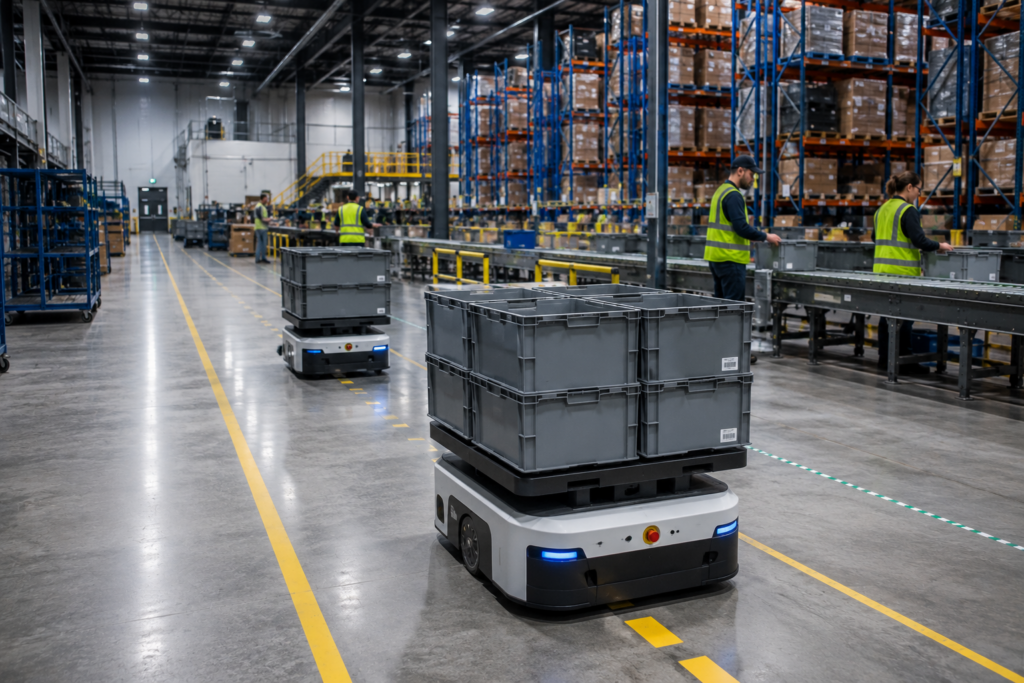
You’ve got forklifts competing with foot traffic, pickers walking 12 miles a shift, and a layout that made sense three years ago but doesn’t today. Material handling inefficiency doesn’t show up as one big line item , it bleeds out slowly through labor hours, near-misses, and throughput ceilings you can’t quite explain.
AMR automation fixes the movement problem. Not by locking your floor into a fixed conveyor grid or buried magnetic tape, but by deploying robots that navigate dynamically, reroute around obstacles, and scale with your operation without a renovation. This guide covers exactly how autonomous mobile robots handle material transport, what separates a good deployment from a frustrating one, and what specs you actually need to compare before you buy.
What AMR Automation Actually Means on the Floor
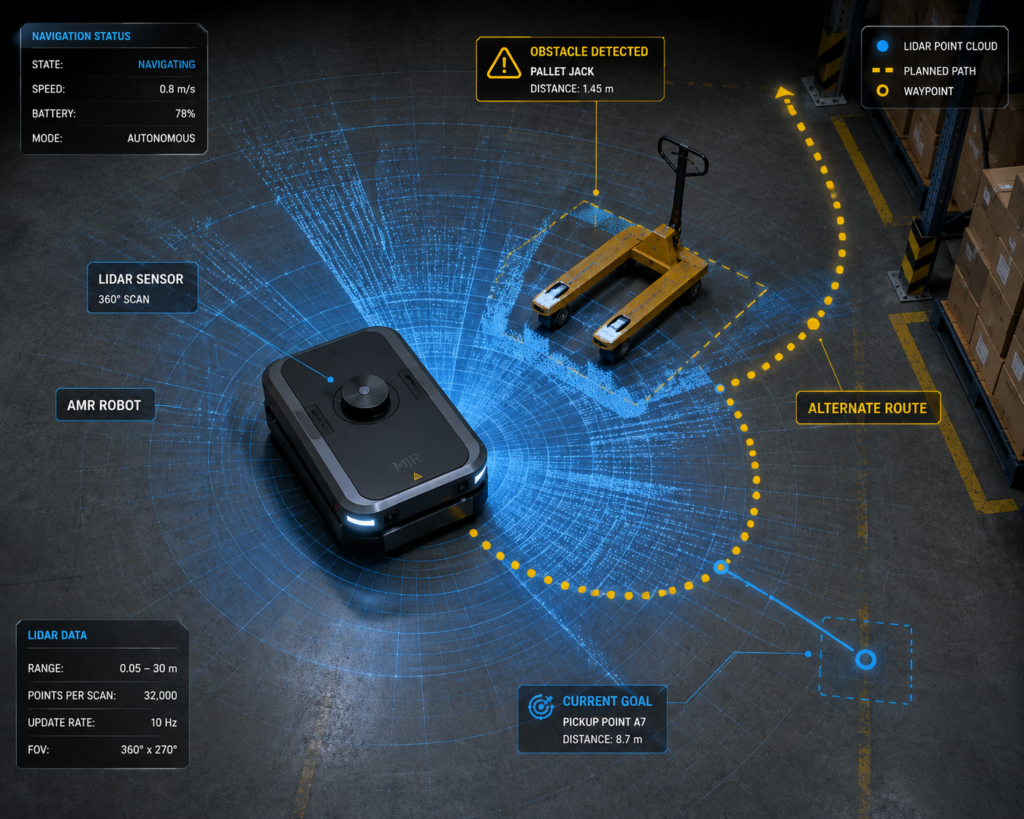
AMR stands for Autonomous Mobile Robot. Unlike an AGV , which follows a fixed path using magnetic tape, wire, or painted lines , an AMR builds a real-time map of its environment using LIDAR, cameras, and onboard compute. It knows where it is. It plans its own route. When a pallet jack rolls into its path, it goes around it instead of stopping and waiting for a human to intervene.
That distinction matters more than it sounds. I’ve watched AGV deployments grind to a halt because someone parked a cart six inches off the line. With AMRs, that’s a non-event.
The core use cases in material handling are straightforward: goods-to-person delivery, cart transport, tote shuttling, and pallet movement. The robot picks up a load at Point A, navigates the shortest available path to Point B, drops the load, and returns for the next task , repeating that loop autonomously across a full shift.
Modern AMRs handle payloads ranging from 30 kg for small tote carriers to 1,500 kg or more for heavy-payload pallet movers. You’ll see names like MiR, Locus Robotics, Fetch, Geek+, and Waypoint Robotics across those ranges. The right class depends entirely on what you’re moving and how far.
How AMRs Navigate and Why It Changes Your Layout Options
AMR navigation is what separates this technology from everything that came before it. Most commercial AMRs use SLAM , Simultaneous Localization and Mapping. The robot builds a 2D or 3D map of your facility during a commissioning drive, then localizes itself against that map on every subsequent run using LIDAR point clouds or visual landmarks.
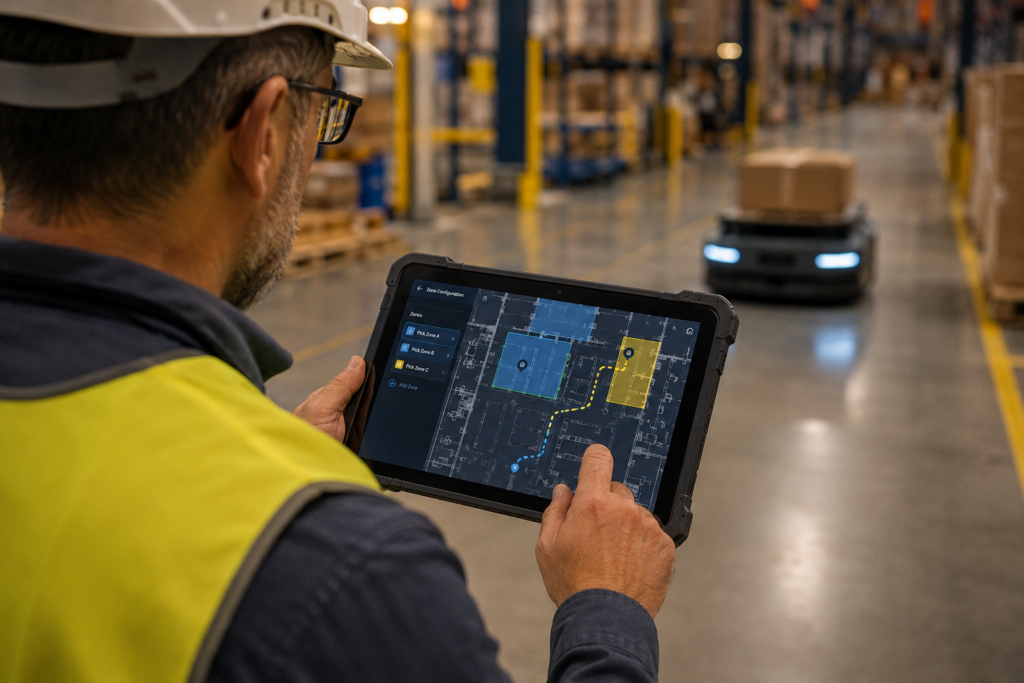
The practical upshot: you don’t modify your floor. No tape, no magnets, no QR code grids stapled to every shelf. You commission the robot, define the pick and drop zones in software, and it figures out how to get there.
Where this gets interesting for plant engineers is dynamic re-routing. AMRs running on a fleet management system , MiR Fleet, for example, or Fetch’s FetchCore , continuously re-optimize paths based on real-time traffic. If two robots converge on the same aisle, one yields. If a zone is blocked, the system reroutes around it. The floor effectively becomes self-managing for transport tasks.
I spent weeks debugging a mixed fleet deployment before realizing the LIDAR on our units was getting confused by a highly reflective stainless-steel vat. Specular surfaces are a real edge case , if your facility has them, ask vendors specifically about their reflectivity handling before you sign anything.
One underappreciated benefit: AMR layouts are reconfigurable in hours, not weeks. You move a workstation, update the map, redraw the zone boundaries in software, and the fleet adapts the same day. Try doing that with a fixed conveyor.
The Real Productivity Case for AMR Material Handling
The argument for AMR automation in material handling isn’t theoretical. It’s measured in meters walked per picker per shift, in dwell time at workstations, and in throughput rates per square foot of floor.
Goods-to-person is the highest-ROI deployment pattern most facilities hit first. Instead of a picker walking to a shelf location, an AMR brings the shelf , or the tote, or the cart , to a stationary pick station. Picker travel drops sharply. Pick rates go up. Ergonomic strain goes down. The math tends to close fast when you’re paying for labor at scale.
The first time I saw this spec wrong was during a goods-to-person eval where the AMR’s rated payload was being compared against average tote weight, not worst-case tote weight. The loaded shelves ran 40% heavier than the average figure. The unit technically handled it, but acceleration curves suffered and cycle times were worse than projected. Always spec to worst-case payload, not average.
Beyond goods-to-person, AMRs handle horizontal transport between production cells, line-side replenishment, WIP (work-in-progress) buffer movement, and outbound staging. Each of those is currently absorbing human labor hours , or forklift time , that could be automated without touching your physical infrastructure.
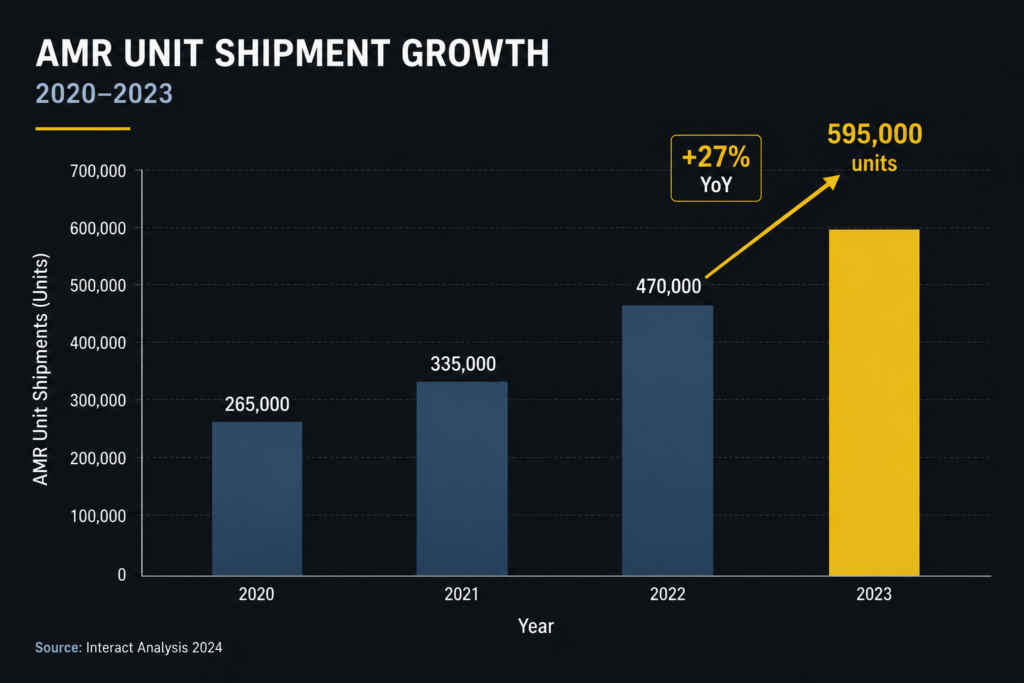
Global AMR shipments reached approximately 595,000 units in 2023, representing a 27% year-over-year increase in logistics and manufacturing deployments.
That growth rate reflects real adoption pressure, not hype. Plants that defer AMR evaluation are increasingly behind competitors who’ve already absorbed the productivity gains. On the floor, the gap compounds: earlier adopters are already on second-generation deployments while late movers are still quoting out their first.
SOURCE: Interact Analysis, World Mobile Robot Report, 2024
Specs That Actually Matter When Comparing AMR Platforms
Most AMR spec sheets lead with payload and speed. Those matter, but they’re not where deployments fail. Here’s what to actually interrogate.
Battery runtime and charging strategy is your throughput ceiling. An AMR running 8-hour shifts on a 10-hour battery with 2-hour charges isn’t keeping up with your operation. Look for units with opportunity charging (15–30 minute top-up between runs) or hot-swap battery systems. MiR’s 250 and 600 models, for example, support autonomous docking to charging stations mid-shift.
Fleet management software integration is where the real operational complexity lives. Does the fleet management system have a native WMS/ERP connector, or are you building a custom API bridge? That question alone has killed timelines on more deployments than I can count. Confirm supported protocols upfront: REST API, OPC-UA, and MQTT are the most common.
Safety certification is non-negotiable. Look for EN ISO 3691-4 compliance, which is the current standard for driverless industrial trucks including AMRs. ANSI/ITSDF B56.5 covers the North American equivalent. An AMR sharing floor space with humans needs certified collision avoidance, not just “obstacle detection.”
The ISO 3691-4 standard itself is worth reading if you’re deploying in a mixed-traffic environment , you can access the standard directly through the ISO official catalog.
Speed envelope is context-dependent. 1.5 m/s sounds fine in an open warehouse. In a dense pick floor with human traffic, you may want configurable speed zones , most modern platforms support this, but verify the granularity. Zone-level speed control matters more than maximum rated speed.
You can use the compare tool at factoryrobots.net to pull AMR specs side-by-side across payload class, battery runtime, safety cert, and navigation type before you get into vendor conversations.
Deployment Realities: What to Plan for Before Day One
AMR automation is faster to deploy than most fixed automation, but “faster” doesn’t mean “plug and play.” Here’s what actually takes time.
Facility mapping and zone configuration takes a full day for a medium-sized facility, longer if your layout is complex or you have dynamic rack systems. Budget for it. Don’t let a vendor wave it away as “just a few hours.”
Staff training is underrated. Operators need to understand how to interact with AMRs safely , not because the robots are dangerous, but because human behavior around robots is unpredictable until people know what to expect. The OSHA guidelines on industrial mobile robot safety provide a solid baseline for a floor-level safety briefing.
WMS integration is where technical debt shows up fast. If your warehouse management system is older or heavily customized, API integration may require middleware. Scope this before you commit to a go-live date.
Pilot before you scale. One robot running one loop for two weeks tells you more than any vendor demo. Measure actual cycle time, not rated cycle time. Watch where it slows down, where it reroutes, and whether the charging strategy holds up across a full shift. Then expand.
The first deployment is always humbling. Paths that look clean on a facility map have unexpected pinch points at shift change. Loading dock doors that open unpredictably confuse navigation in ways you won’t anticipate until it happens. Plan for a two-to-four week optimization window after initial deployment before you call it production-ready.
Key Takeaways
- Spec AMR payload to worst-case load weight, not average , undersized units kill your projected cycle times before the deployment even stabilizes.
- SLAM-based navigation means no floor modification, but specular surfaces (stainless steel, polished concrete) can confuse LIDAR , test in your actual environment.
- Goods-to-person is typically the fastest-ROI deployment pattern; start there before expanding to line-side or inter-cell transport.
- Confirm WMS/ERP integration protocol (REST, OPC-UA, MQTT) before vendor selection , this is where timelines slip, not hardware.
- Budget a 2–4 week optimization window post-deployment; rated cycle times and real-world cycle times diverge until the fleet is tuned to your floor.
Frequently Asked Questions
What’s the difference between an AMR and an AGV? An AGV follows a fixed path using magnetic tape, wire, or painted lines and stops when its path is blocked. An AMR uses LIDAR and onboard mapping to navigate dynamically, rerouting around obstacles in real time. For facilities with changing layouts or mixed human-robot traffic, AMRs are significantly more practical to operate and scale.
What payload capacity do AMRs typically support? Commercial AMRs range from roughly 30 kg for small tote carriers up to 1,500 kg or more for heavy-payload pallet movers. Most goods-to-person applications fall in the 100–600 kg range. Always spec to your worst-case loaded weight, not average , that’s where most deployment projections go wrong.
Do AMRs require changes to the facility floor or infrastructure? No. That’s one of their core advantages. SLAM-based navigation doesn’t need tape, magnets, or embedded wires. You commission the robot, build the map, configure zones in software, and deploy. Infrastructure changes , charging station installation and network access points , are minimal compared to fixed automation systems.
How long does a typical AMR deployment take? A single-robot pilot can be operational in one to three days. A full fleet deployment with WMS integration typically takes two to six weeks, depending on the complexity of your software environment and the size of the facility. Plan for a separate optimization phase after go-live before treating the deployment as production-stable.
Start Moving Materials Smarter
AMR automation isn’t a moonshot project anymore. The platforms are mature, the safety standards are solid, and the ROI math closes faster than most capital equipment decisions you’ll make this year. The facilities winning on throughput right now aren’t waiting for a perfect use case , they’re running a pilot, measuring it honestly, and scaling what works.
If you’re ready to spec actual units, browse the full AMR and mobile robot inventory at factoryrobots.net/shop/ , full specs and pricing on every listing, no quote forms, ships from stock.